
Can I Use an AI Receptionist if I Work from Home? Yes — And Here's Why Home-Based Contractors Need It Most
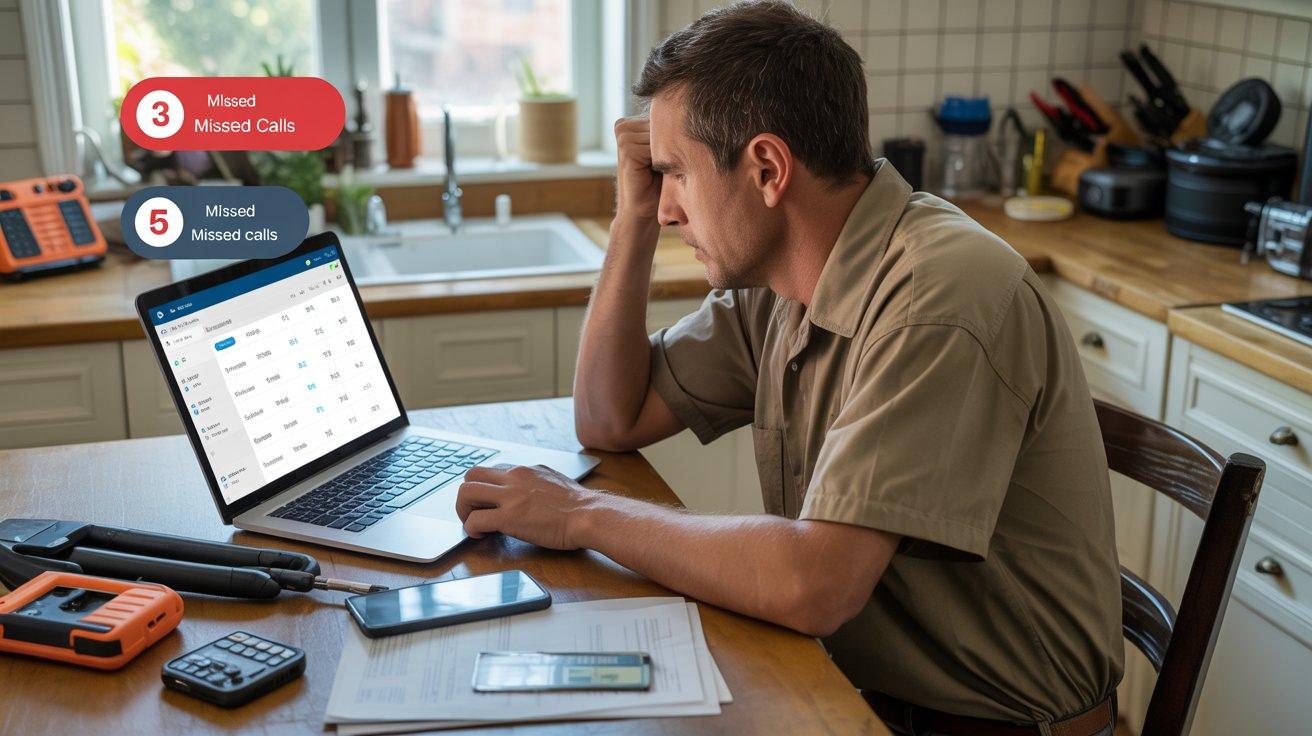
Tom is a licensed electrician running a residential electrical contracting business out of his house in the suburbs of Columbus, Ohio. Two vans, three technicians, and a Google Ads campaign he started running last spring. His "office" is the kitchen table — ServiceTitan on the laptop, phone in his pocket, coffee going cold by 9 AM. For the first few years, the arrangement worked fine.
He answered calls when he could, returned the ones he missed, and stayed busy enough that it felt like the system was holding together. Then something shifted. The leads started coming in faster — the ads were working — but Tom started noticing that by the time he called back a missed number from the afternoon, the homeowner had already booked with someone else. "I'd pull into the driveway at 6 PM and have four voicemails," he told a colleague at a trade association meeting.
"And half of them were already gone." He didn't need more leads. He was generating plenty. What he needed was a way to answer the phone when he was pulling cable behind a panel board 30 feet off the ground. And he needed it to book the job before anyone called back to say they'd found someone else.
This is the situation most home-based contractors are in — and it's one where an AI receptionist doesn't just help. For many operators, it's the difference between a business that grows and one that plateaus.
Yes, You Absolutely Can — And the Setup Is Simpler Than You Think
The short answer is yes: an AI receptionist works for home-based operations. In fact, the physical location of your "office" is almost completely irrelevant to how AI call handling functions. Whether you're running calls from a commercial office, a garage, or a kitchen table, your phone number still rings — and an AI system answers it in under two seconds, qualifies the caller, and books the job directly into your dispatch software, regardless of where you are when the call comes in.
There's no requirement for dedicated office infrastructure, no need for a front-desk employee, and no requirement that you be physically present for calls to get handled correctly. If your phone number forwards to the system, the system handles it.
But the more important question isn't whether you can use it from home. It's why home-based and small-team operators arguably have the most to gain from it — because the revenue leak that AI call handling solves is most severe exactly in the situations home-based contractors face every day.
The Home-Based Contractor's Specific Revenue Problem
When a mid-size contractor with a full-time dispatcher misses a call, it's usually because volume exceeded capacity during a surge. That's a real and expensive problem — but it's intermittent.
When a home-based or owner-operated contractor misses a call, it's usually because the person who answers the phone is also the person on the job. That problem doesn't happen occasionally. It happens every day, every time you're on a job site, under a sink, on a roof, or behind a panel — which is to say, most of your working hours.
The data on what this costs is sobering. Home service businesses lose an average of $300 to $1,200 per missed call. Small-to-medium-sized home service businesses — the segment where most home-based contractors sit — miss an average of 62% of their inbound calls, according to industry research. That number is more than double the already-painful 27% industry average, precisely because smaller operations have fewer people available to answer at any given moment.
Over a year, the average small business loses $126,000 in revenue from missed calls — not from a lack of leads, but from a failure to convert the calls that marketing already generated. If you're spending money on Google Ads, local service ads, or any form of lead generation, a significant portion of that budget is currently generating calls that ring while you're on a job and go unanswered.
Why Voicemail Is Not a Solution
A common workaround for home-based operators is a professional voicemail greeting: "Thanks for calling [Business Name], we're currently on a job but we'll call you back soon." It feels like a placeholder. The data says it's a revenue graveyard.
By 2026, the average caller is willing to wait only 2.3 seconds for a phone to be answered before their brain triggers a "next" response — down from 8 seconds in 2020. That's not a judgment about your business; it's a behavioral reality about how home service customers call. When someone's pipe is leaking, their furnace is down, or their lights aren't working, they aren't in a patient frame of mind. They need someone to answer.
What happens when they don't reach you? 67% of callers who can't reach a service business immediately dial a competitor. And of the callers who do reach voicemail? Up to 85% hang up without leaving a message — they simply don't bother, and they don't call back.
The job is gone. The Google Ad dollar that drove that call is wasted. And you don't even know it happened until you notice the call log the next day.
For a home-based contractor running lean, this isn't an occasional leak. It's the structural ceiling on how much of your marketing spend actually converts into revenue.
The Speed-to-Lead Problem Is Worse for Home-Based Operators
Beyond missed calls, there's a second revenue problem that home-based operators face more acutely than larger operations: callback delay.
When you do see a missed call and return it — from the job site, at the end of the day, the next morning — you're already fighting a losing race. Research shows that responding to a new lead within 5 minutes makes you 21 times more likely to qualify it compared to calling back 30 minutes later. By the time you've finished the job and pulled your phone out of your pocket, the window is nearly always gone.
78% of home service customers book with the first contractor who actually answers their call. Not the best price. Not the most reviews. The first one to pick up. When you're on a job site and your competitor has a system that answers in two seconds, you're losing jobs not because you're less skilled or less competitive — but because of a timing gap you have no way to close on your own.
An AI receptionist eliminates that gap. The call gets answered in real time. The job gets booked while the caller's intent is highest. By the time you finish the job and check your schedule, the new booking is already there — created without anyone returning a call, leaving a tag on the door, or relying on a voicemail the customer didn't leave.
What This Looks Like in Practice for a Home-Based Operation
For a home-based contractor, AI call handling doesn't change how your business works. It fills the gap that your existing model structurally cannot.
During the day, when you're on job sites and physically unavailable: every inbound call gets answered in under two seconds. The caller's job type is identified — emergency or routine, residential or commercial, your service area or outside it. If it's a qualified lead, the job gets booked directly into ServiceTitan or Housecall Pro. You see it on the board.
In the evenings and on weekends — when 60% of buyer-intent calls in the trades arrive — the same thing happens. A homeowner discovers a problem with their water heater on a Saturday evening. They call your number. Your competitor's phone goes to voicemail.
Yours gets answered, the job gets qualified, and the booking lands in your dispatch software while you're at dinner.
When your marketing spend generates a surge of inbound calls — a campaign push, a seasonal spike, a few days after a major storm in your market — every call gets handled concurrently. There's no ceiling on simultaneous call volume, so a busy afternoon doesn't produce a stack of missed calls for you to sort through before bed.
Your kitchen table office doesn't need to change. Your service area doesn't need to change. Your technicians don't need to know anything changed. What changes is that the calls you were losing while you were working start converting into jobs that show up in your schedule — before any competitor gets a chance to answer.
The Audit-First Argument for Smaller Operations
One of the most important points for home-based contractors evaluating any call handling solution is this: you shouldn't guess at what you're losing. You should know.
Pulling 30 days of call log data will almost always surface a pattern that's larger than the owner expected. Missed calls cluster in specific windows — typically early mornings, evenings, and weekend hours — because those are when a home-based operator is most likely to be unavailable. The dollar figure attached to those missed calls, calculated against your average job value and your close rate, is usually the number that turns an abstract consideration into an immediate priority.
The right approach to any AI call solution isn't to deploy first and ask questions later. It's to audit first, understand exactly where revenue is leaving your pipeline, and then configure a solution around the actual problem — not a generic template. For a home-based contractor who doesn't have a dispatcher building that picture, that audit step is often the first time they've seen their true call performance in a single view.
That number, once you've calculated it, tends to make the rest of the decision straightforward.
How Enumsol Works for Home-Based and Small-Team Contractors
Enumsol's AI Voice Receptionists aren't just built for large multi-truck operations — the process is specifically designed to produce results whether you have a full-time dispatcher or you're currently the dispatcher.
Every engagement starts with a 30-day audit of your call logs and missed conversation patterns — identifying exactly when calls are arriving, where they're leaking out, and what the right qualification and booking logic looks like for your specific trade and service area. That audit is the baseline. The system that gets deployed is measured against it.
For a home-based contractor, this often surfaces something immediately actionable: the calls arriving between 5 PM and 8 AM, the weekend spikes after weather events, the campaign-driven volume that arrives while you're on a job. Those are the revenue windows where a home-based operation is most exposed — and they're the first channels that get plugged when a solution goes live.
A plumbing operator running this process captured 4.3 times more qualified emergency calls per week. An HVAC contractor saw a 58% increase in after-hours booked jobs within 90 days. For home-based operators, those results come from the same source they do for larger businesses: answered calls that previously rang out, converted by a system that was on when you couldn't be.
What to Think Through Before You Start
If you're a home-based or small-team contractor considering AI call handling, here's the honest checklist:
Confirm your call volume is there. AI call handling produces the highest ROI when there's real missed-call volume to recover. If your business currently receives fewer than 10 to 15 meaningful inbound calls per week, the math may take longer to justify. If you're running any paid advertising, that threshold is almost certainly already exceeded.
Know your average job value. The math on whether this is worth it is simple: your average job value times the number of qualified calls you're currently missing. Even recovering two to three jobs per month at $800 average ticket produces meaningful annual revenue from a fraction of your current leak.
Don't skip the audit step. The strongest argument for any call handling solution — for a home-based operator especially — is your own data. Pull 30 days of call logs before committing to anything. The pattern will tell you where to focus.
Require dispatch software integration, not just message-taking. For a home-based contractor who reviews their schedule in ServiceTitan or Housecall Pro, a system that sends you email summaries is not the same as one that creates the job record automatically. The former adds to your morning to-do list. The latter fills your calendar while you sleep.
Conclusion
The question of whether a home-based contractor can use an AI receptionist has a simple answer: yes, without complication, and often with greater impact than larger operations. The physical location of your office is not a factor. What matters is whether calls are reaching a system that answers them, qualifies the job, and books it into your dispatch software before the caller has a chance to call your competitor.
For a home-based HVAC, plumbing, electrical, or roofing operator, the structural reality is that you are the technician and the dispatcher simultaneously — which means every hour you're on a job site is an hour your phone goes unanswered. The revenue that leaks through that gap isn't a small-business problem or a home-office problem. It's a capacity problem, and capacity problems have practical solutions.
You've already done the hard work of generating the leads. So the real question worth sitting with is: how much of your own marketing spend are you converting into jobs, and how much of it is ringing through to your competitor while your hands are full?
Enumsol helps HVAC, plumbing, electrical, and roofing contractors — from owner-operators to multi-truck operations — stop losing revenue at the phone, starting with a free 30-day call audit. Learn more at enumsol.com.