
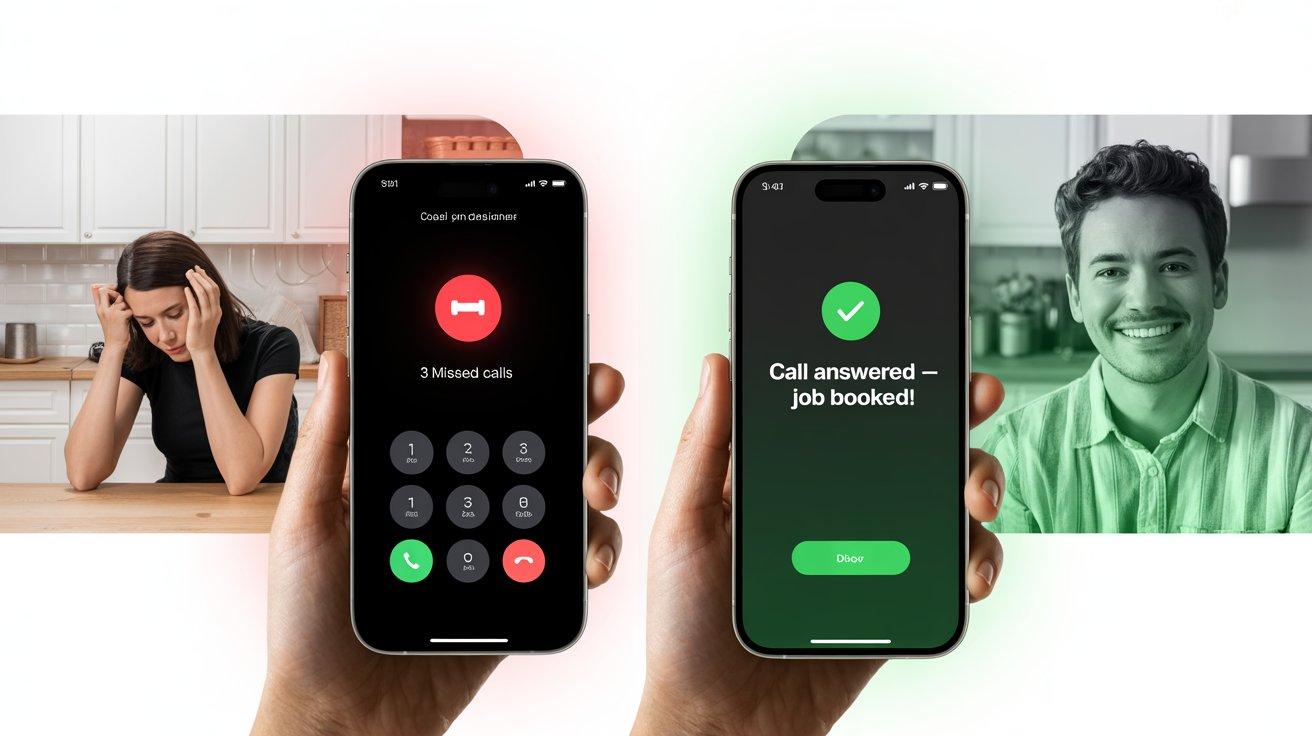
Modern AI receptionist technology delivers reliable results for home service businesses. ### Two Contractors. Two Completely Different Experiences.
Rick runs a mid-sized HVAC company in the suburbs of Nashville. Last spring, he deployed an AI voice solution after a marketing consultant told him it would "solve his after-hours problem." Setup took about forty minutes. He pointed the system at his website, typed in his hours and a few FAQs, and forwarded his business line. For two weeks, he thought it was working.
Then a customer left a Google review explaining she had called twice about a broken heat pump, been told the same incorrect information about his service area both times, and hired a competitor. Rick pulled his call logs and found seventeen interactions where the AI had given wrong or incomplete information — including four after-hours emergency calls that should have been routed immediately to his on-call tech. None of them were.
Forty-five miles away, a plumbing company of similar size deployed a different kind of system. Before a single line of configuration was written, the deploying team audited thirty days of their call logs, mapped their actual emergency routing rules, verified their service area zip by zip, and built the knowledge base around real caller scenarios from their specific market. They ran a two-week test on after-hours calls only, measuring pickup rate, lead capture, and booked jobs against the previous period. The numbers moved.
They expanded.
Both contractors deployed "AI receptionists." The reliability of the two systems wasn't even in the same category.
This is the honest starting point for any conversation about how reliable AI receptionists are in 2026: the technology is genuinely capable. The results depend almost entirely on how it's been built, configured, and maintained — and whether anyone is accountable for the outcomes.
Where the Technology Actually Stands in 2026
The gap between what AI voice systems could do two years ago and what they can do today is significant. The numbers from real-world deployments tell a clearer story than any vendor pitch.
Analysis of 347,609 real business calls handled by AI receptionists across 2,074 businesses in 2025 found that top-performing systems resolve 90 to 95% of calls without human help, answer in under 5 seconds, and maintain 99% positive caller sentiment. That's not a projection. That's measured performance data from deployed systems across real business environments.
On voice quality specifically — the factor that determines whether a caller trusts the system or immediately asks for a human — modern AI has crossed a meaningful threshold. In blind tests, 85 to 95% of people cannot distinguish advanced AI voices from human receptionists. The robotic monotone of early automated phone systems is gone. Current speech synthesis includes natural pauses, appropriate inflection, and conversational pacing that passes muster even for callers who are paying attention.
On response latency — the technical measure of how quickly the AI replies after a caller stops speaking — best-in-class systems now achieve response times around 510 milliseconds. The gap from natural human conversation speed is one callers don't perceive as unnatural in practice. Sub-second response eliminates the awkward silence that used to make early AI systems feel obviously non-human.
On availability, the performance ceiling is literally 100%: an AI system doesn't call in sick, doesn't go on vacation, and doesn't have a bad Tuesday where call quality starts slipping. A human receptionist works 40 hours per week. AI operates 168 hours per week — every evening, every weekend, every holiday, at the same level of quality regardless of call volume or time of day.
For home service businesses specifically, where the revenue case is built on after-hours capture and peak-season overflow, these aren't abstract statistics. They're the difference between a truck rolling to an empty house and a job booked at 10 PM on a Sunday.
The Honest Numbers on Where AI Still Falls Short
Any assessment of AI reliability that doesn't address the failure modes is a sales pitch, not an evaluation. The limitations are real — and they matter specifically for home service businesses making decisions based on revenue impact.
Accuracy degrades with poor configuration. The 85 to 95% accuracy figure for routine inquiries is real — but it carries an important qualifier: when trained on business-specific information. A system trained on a thin knowledge base — generic FAQs, a website crawl, a few typed sentences — will produce generic, inaccurate answers that damage caller trust. When AI knowledge bases have gaps, the system either fills them incorrectly or hits dead ends and loops. The failure isn't the technology.
It's the input quality.
Accents, background noise, and fast speech create recognition errors. Analysis of over 130,000 calls from home service businesses found that misrecognition is a leading cause of AI failure. A caller with a heavy regional accent describing a plumbing emergency over road noise from a car may not be understood correctly on the first attempt. Well-configured systems handle this with graceful clarification requests and fallback routing. Poorly configured ones frustrate the caller until they hang up.
Multi-turn context can break down. When a caller says "actually, let me change that — I need Thursday, not Friday," and the AI responds as if the conversation is starting fresh, the interaction fails. Voice AI systems can struggle to maintain context across several turns of a conversation, leading to fragmented exchanges where the caller has to repeat themselves. The best platforms handle this gracefully; the weakest ones create the most frustrating caller experience of all — one that feels robotic precisely because nothing the caller says is being tracked.
Emotional calls require human judgment. A homeowner calling in obvious distress — panicked about flooding, frustrated about a missed appointment, anxious about a gas smell — needs tone matching and empathy that current AI handles imperfectly. The system can detect escalation signals and route to a human, but the routing has to be configured correctly. A system that keeps trying to resolve a frustrated caller's complaint through a menu tree rather than connecting them to a live person doesn't fail gradually — it fails completely, often with a review attached.
The Consumer Preference Statistic Every Contractor Should Understand Correctly
A widely cited Gartner survey found that 64% of customers would prefer companies not use AI for customer service — and 53% said they would consider switching to a competitor if they found out a company was planning to implement AI for customer service.
That statistic gets cited frequently as an argument against AI adoption. Read in context, it's actually an argument for getting the deployment right.
Here's what that number reflects: consumer experience with AI in customer service across most industries — chatbots that don't understand the question, phone trees that never lead anywhere useful, and systems that make it harder to reach a human when there's a real problem. The frustration is legitimate. The AI-powered customer service experiences that generated that 64% figure earned the skepticism.
But the context for home services is fundamentally different.
A homeowner calling an HVAC company at 9 PM because their system quit isn't trying to navigate a chatbot to file a complaint or track a package. They're trying to get someone to help them with an urgent problem. The question they're asking isn't "do I want to talk to AI?" It's "is someone going to answer this phone and get me on the path to a solution?" An AI that answers immediately, confirms it can help, and either routes them to an on-call tech or books them for the first available appointment tomorrow has solved the problem — regardless of whether the caller knew they were talking to AI.
A 2025 survey of over 1,000 US homeowners found that 53% are comfortable with AI handling initial inquiries — and comfort is even higher among millennials, who represent a growing share of homeowner-age customers. The gap between the Gartner number and this one reflects the difference between AI used to make service harder to access versus AI used to make it faster to access.
Research also found that 54% of consumers trust human agents more than AI for product recommendations and high-stakes advisory interactions. For complex, judgment-intensive conversations — that preference is legitimate. But qualifying a plumbing lead, confirming a service area, routing an HVAC emergency, or booking a tune-up appointment does not require that kind of trust. Those are exactly the calls where speed and availability matter more than whether a human or an AI is on the other end.
What "Reliable" Actually Means for a Trades Business
For a contractor evaluating whether to trust an AI voice system with inbound calls, reliability needs to be defined in terms of what actually affects revenue — not abstract accuracy percentages.
There are four reliability measures that matter to a home service operation:
1. Did it pick up? This is the foundational measure. Every call that goes to voicemail instead of an AI that answers is a potential job already at risk. Research consistently shows 85% of callers who reach voicemail never call back.
A system that answers 100% of calls — regardless of time, day, or volume — is reliable on this dimension by definition.
2. Did it capture the right information? Name, number, address, job type, and urgency level: these are the data points that convert a call into a dispatch action. A reliable system captures them correctly on the first attempt for the vast majority of calls. A system that gets the phone number wrong or books the wrong service type is not reliable in the way that matters.
3. Did it route correctly? Emergency calls must go to the on-call line immediately. Routine calls can be booked or captured. Out-of-area calls should be declined gracefully.
A system that routes correctly across these categories is doing the core job. One that misclassifies an emergency as a routine scheduling call creates liability and direct revenue loss.
4. Did it update the dispatch calendar accurately? For systems integrated with ServiceTitan or Housecall Pro, reliability extends to whether the booked appointment actually appears correctly in the dispatch system — with the right job type, time window, and caller contact information. A confirmation that books the wrong date or wrong address creates downstream problems that take human time to clean up.
Systems that perform reliably on all four of these measures, for 90% or more of calls, represent the current capability ceiling of well-deployed AI voice technology. Most systems that fall short do so not because the technology failed, but because the configuration didn't reflect the specifics of the business accurately enough.
The Deployment Gap: Why Good Technology Produces Bad Results
This is the most important reliability factor that contractors rarely hear about before they deploy.
Organizations that struggle with AI investments often fail not because the technology doesn't work, but because of implementation gaps — insufficient upfront configuration, lack of ongoing monitoring, and failure to update the system as the business changes. Research on AI adoption consistently finds that successful companies invest significantly more in implementation quality than their struggling counterparts.
For home service businesses, the deployment gap shows up in specific ways:
A system that wasn't given accurate service area boundaries will confirm coverage for callers in zip codes you don't serve — costing you technician drive time when you try to honor it, or burning trust when you have to decline after a booking is already made.
A system that wasn't told your emergency routing rules will treat a burst pipe the same as a routine drain cleaning inquiry — and route the caller to your booking calendar instead of your on-call tech.
A system that hasn't been updated since you added electrical services to your menu six months ago will tell callers you don't offer that — and they'll call a competitor who does.
These aren't AI failures. They're configuration failures. The distinction matters because the fix is different. A technology problem requires a technology solution.
A configuration problem requires a managed service model where someone is accountable for keeping the system accurate and watching the results.
The Reliability Standard That Home Service Businesses Should Require
Given everything above, here is what a reliably deployed AI voice solution should deliver for a mid-to-high-volume HVAC, plumbing, electrical, or roofing operation in 2026:
Answer rate: 100% of inbound calls, 24/7/365, including peak season spikes where call volume may be 3 to 5 times normal levels, without any degradation in response time or quality.
Routine inquiry accuracy: 85 to 95% accuracy on business hours, service area confirmation, trip charges, services offered, and emergency protocol routing — when the knowledge base accurately reflects current business operations.
Emergency escalation: Correct identification and immediate routing of emergency-language calls on the first attempt — no menus, no holds, no booking into a routine slot.
Dispatch calendar accuracy: Booked appointments appear correctly in ServiceTitan or Housecall Pro, with accurate job type, time window, and caller contact information.
Fallback routing: Any call the AI cannot handle confidently routes to a live person or captures the caller's information for a callback — no dead ends, no repeated loops, no frustrated hangups.
Ongoing monitoring: Call transcripts reviewed regularly for accuracy drift, knowledge base updates pushed when business information changes, and performance data tracked against the baseline metrics established at deployment.
This is what Enumsol's AI Voice Receptionists are built and maintained to deliver — starting with a 30-day audit before any configuration is written, and with ongoing optimization throughout the engagement. The audit-first approach isn't a sales process. It's the methodology that makes the difference between the contractor who captured 58% more after-hours booked jobs in 90 days and the one who got seventeen wrong answers and a one-star review.
The Hybrid Model That Actually Works
The most reliable deployment model in 2026 is not AI replacing your team. It's AI handling the 70 to 80% of calls that are routine — qualification questions, scheduling requests, after-hours intake, FAQs — while your dispatchers and CSRs handle the 20 to 30% that require human judgment, empathy, or authority.
The contractors winning in this market aren't the ones who've gone all-in on automation — and they're not the ones still routing everything through a single dispatcher. They're the ones who've identified exactly which calls should be handled by AI and which require a human, and built a system that makes that split seamlessly and consistently.
This isn't a hedge. It's an operational truth. The reliability of an AI receptionist in 2026 is high enough — for the right call types, with the right configuration, with ongoing oversight — to make a measurable difference in revenue capture for home service businesses at scale.
Conclusion
AI receptionists in 2026 are genuinely reliable — within a clearly defined scope, with proper configuration, and with an accountable deployment model. They are not reliable out of the box, not reliable with thin knowledge bases, and not reliable without someone watching the results and updating the system as the business evolves.
The technology has crossed the capability threshold where a well-deployed system answers faster than a human dispatcher, captures more calls than any voicemail strategy, and maintains consistent quality at 2 AM on a Tuesday that no single employee can match across a full year of operations. Analysis of nearly 350,000 real business calls shows top AI receptionists resolving 90 to 95% of calls without human involvement, with 99% positive caller sentiment — numbers that represent a genuine reliability benchmark, not a marketing claim.
The failure stories — and they exist — almost always trace back to deployment decisions, not to the technology itself. A system that wasn't configured with real business data, wasn't tested against a measurable baseline, and wasn't monitored after launch will underperform. A system that was built correctly from the start, tested before expansion, and updated as the business changes will deliver on the revenue case.
The question for every home service business owner evaluating this technology in 2026 isn't whether AI receptionists are reliable enough — the data says they are, under the right conditions. The question is whether the vendor you're evaluating is accountable for building and maintaining those conditions, or just selling you the tool and leaving you to figure it out?
Sources: Gartner Customer Service Leaders Conversational GenAI Study (2025); BCG AI Adoption in 2024 Industry Report; Invoca Call Conversion Benchmarks Report: Home Services 2025.