
What's the Best AI Receptionist for Your Home Service Business? A Contractor's Buying Guide
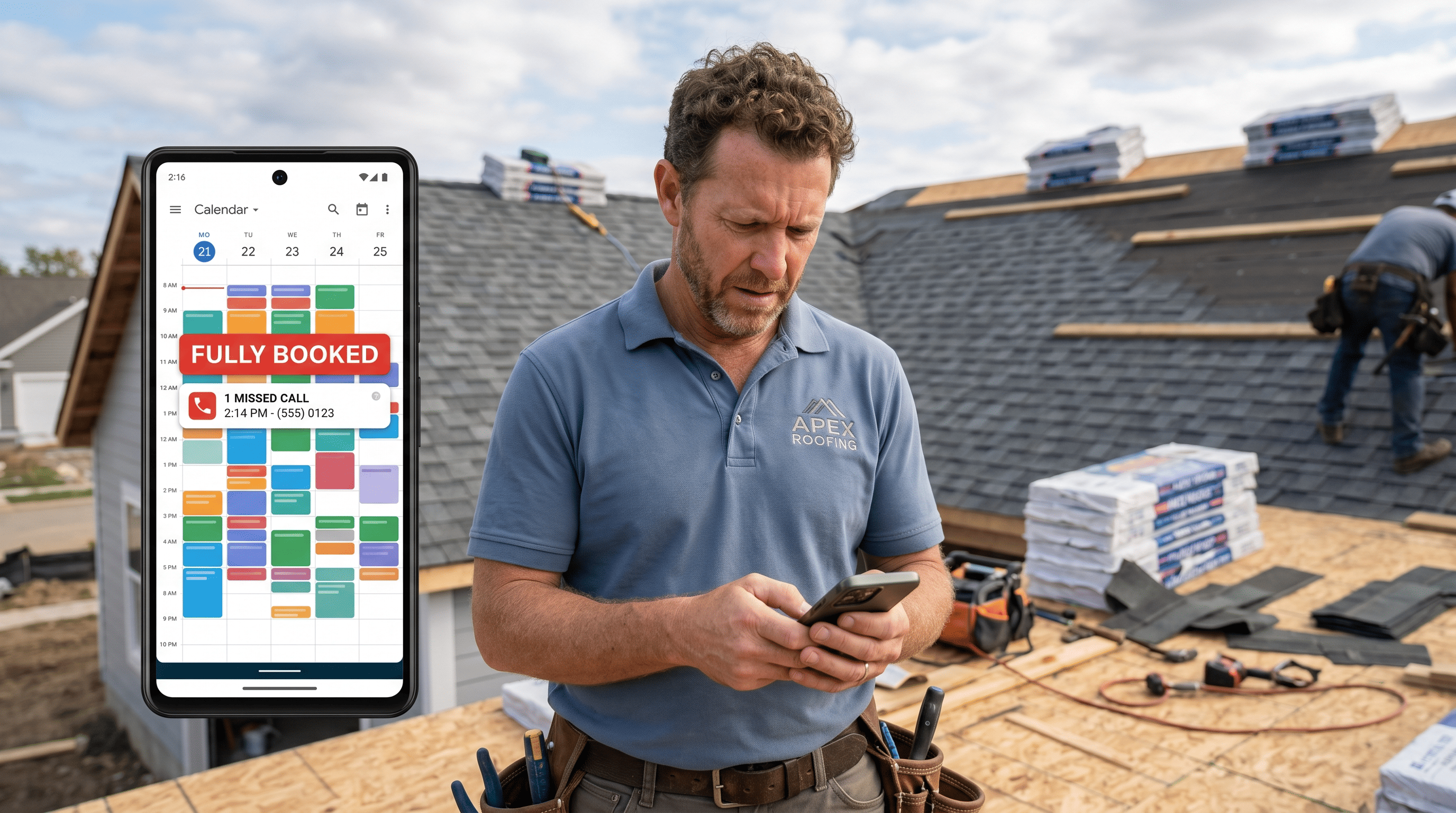
Derek owns an electrical contracting company in the suburbs of Atlanta. Three vans on the road, a dispatcher holding it together, and a Google Ads budget he's been growing steadily for two years. Business is good — but Derek started noticing something. His dispatcher was logging into work every morning to a stack of voicemails left overnight.
Some were quote requests. Some were customers following up on estimates. And a few, every single week, were emergency calls — a homeowner with a sparking panel, a family with no power — who had already called someone else by the time Derek's team opened at 7:30 AM. He couldn't calculate exactly what he was losing.
But he knew it was real. He started looking at AI receptionist options and quickly hit a wall: there were dozens of them, they all looked similar on the surface, and none of the comparison articles were written for someone who manages service vans, not software subscriptions. This guide is written for Derek. And for every HVAC, plumbing, electrical, and roofing operator who needs the same question answered without the tech jargon.
Start Here: The Wrong Question Most Contractors Ask
When home service business owners start evaluating AI call handling, the first question is usually "which one is the best?" That question is almost impossible to answer in the abstract — because "best" depends entirely on what's costing you money right now.
The right starting question is: where is revenue leaking in your call operation?
Is it after-hours calls going to voicemail when your highest-converting, most urgent customers can't reach you? Is it campaign overflow — your dispatcher buried under call volume when a seasonal push spikes the phones and qualified leads slip through? Is it speed-to-lead — your team calling back 40 minutes after a customer already booked with the competitor who picked up first?
The answer shapes everything else. A contractor losing primarily to after-hours abandonment needs a different solution priority than one losing to mid-day overflow. Getting clear on your specific leak before evaluating any solution is the step most buyers skip — and it's the reason so many contractors end up with a tool that looked good in a demo but didn't move their numbers.
Industry research paints a clear picture of the problem's scale. 62% of calls to small businesses go unanswered. A study analyzing real call data from 45 contractors over seven months found 74.1% of inbound calls went unanswered. And when those calls go to voicemail?
There's an 85% chance the customer does not call back — they call your competitor instead. The math on annual revenue loss from missed calls across home service businesses ranges from $45,000 to $120,000 per year.
The best AI receptionist is the one that solves your version of that problem — not the one with the most features on a spec sheet.
What the Market Actually Looks Like
The AI reception market has expanded quickly, and it's worth understanding the landscape honestly before committing to anything.
Generic small business tools sit at the lower price tiers. These platforms are designed to work for any business — a yoga studio, a law office, a salon — and they do the basics: answer calls, take messages, send email summaries, sometimes book into a calendar. For a home service business running real call volume, the limitation shows up fast. These tools don't know the difference between a routine service call and an emergency dispatch.
They don't understand your service area zip codes, your trip charge structure, or how to qualify a job before booking. They collect a name and a callback number. That's not enough.
Industry-specific solutions are built around the specific call patterns of particular business types. In the trades, this means the system understands what "no heat," "burst pipe," or "panel sparking" actually means in terms of urgency — and responds accordingly. It books into ServiceTitan or Housecall Pro, not just a generic Google Calendar. It knows the difference between a $400 service call and a $12,000 system replacement and routes the call with that context.
15.9% of all inbound calls to trade businesses contain urgency language — words like "emergency," "ASAP," "today," or "urgent." These are your highest-converting, highest-margin calls. A generic system treats them the same as every other call. A trade-specific one doesn't.
Managed service providers handle not just the technology but the deployment, configuration, and ongoing optimization. This is fundamentally different from a self-serve SaaS tool. With a managed approach, the system that goes live is configured around your actual operation — your service area, your job types, your dispatcher's workflow — and it gets actively refined over time rather than set up once and left alone.
Hybrid AI and human models combine automated call handling with live human backup for complex or sensitive situations. These are worth knowing about, but for the majority of calls a home service business receives — service requests, quote inquiries, job booking, emergency triage — the complexity that demands a human on the line is the minority.
The Five Criteria That Actually Matter for a Trades Operator
Forget the feature comparison tables. Here are the five questions a home service operator should be asking when evaluating any AI call solution:
1. Does it integrate natively with your dispatch software?
This is non-negotiable for any contractor running ServiceTitan or Housecall Pro. If the system captures a call and then sends an email to your office for someone to manually enter into the dispatch platform, it has not solved the problem — it has just moved the bottleneck. A job should land in your dispatch system automatically, with the right job type, service address, and contact information, before your dispatcher arrives in the morning.
2. Does it understand trade-specific call types?
Ask any vendor you're evaluating to walk you through how their system handles a 10 PM call from a homeowner describing a furnace that stopped working. Does it know to escalate that as an emergency? Does it confirm the service area before booking? Does it distinguish between a customer with an active maintenance plan and a new lead?
A system built for the trades knows the answers. A generic one doesn't — and you'll find out the hard way in a real call.
3. How does it handle seasonal surges and campaign spikes?
One of the most expensive revenue leaks in the trades isn't after-hours voicemail — it's dispatcher overflow during a marketing push or the first week of cold weather when every HVAC company's phones are ringing simultaneously. Your solution needs to handle concurrent call volume without degradation, which rules out anything that can only process one call at a time.
4. What does setup actually include — and what does ongoing optimization look like?
There's a meaningful difference between a vendor who hands you login credentials and a help article, and one who configures the system around your actual call patterns, tests it against a baseline, and actively refines it based on what's working. A self-serve SaaS tool deployed in 10 minutes is not the same as a managed deployment built around 30 days of your real call history. The first is a tool. The second is a revenue operation.
5. Can they show you results against a real baseline — not just a demo?
Any vendor confident in their solution should be willing to demonstrate it on a controlled, real-world basis before asking for a full commitment. That means a proof-of-concept on a single call channel, measured against your existing pickup rate, qualified leads generated, and jobs booked. If a provider won't run a test with measurable outcomes, that tells you something about what they expect those outcomes to be.
The Trap Most Contractors Fall Into
The most common mistake in evaluating AI call solutions is optimizing for the wrong variable. Contractors with a technology bias gravitate toward the most feature-rich option. Contractors focused on cost gravitate toward the cheapest monthly price. Neither approach produces the right outcome.
A feature-rich tool that isn't configured for the trades will generate a mediocre caller experience and won't move your booked job numbers. A cheap tool that doesn't integrate with ServiceTitan or Housecall Pro will create manual work downstream that your dispatcher absorbs. And any tool that's deployed without a clear baseline — without knowing what your current pickup rate and after-hours miss rate actually are — can't be evaluated for whether it's working.
Setup times for general AI receptionist platforms range from 60 seconds to a few hours, and most SMB-focused tools are designed for quick self-configuration. That speed is a selling point in the marketing. In practice, it means the system knows nothing about your service area, your job types, your dispatch protocols, or the difference between a routine tune-up and an emergency call when it goes live. Fast setup and correct configuration are not the same thing.
The right frame for this decision isn't "which tool has the most features for the lowest price?" It's "which solution will recover the most revenue from the leads I'm already paying to generate?"
How Enumsol Approaches This Problem
Enumsol's AI Voice Receptionists are built exclusively for HVAC, plumbing, electrical, and roofing contractors — not adapted from a generic call handling tool, but purpose-built for the trades from the ground up.
More importantly, Enumsol doesn't start with a deployment. It starts with a 30-day audit of your existing call logs — identifying exactly where qualified leads are falling out, whether that's after-hours gaps, dispatcher overflow, or speed-to-lead failures during marketing campaigns. That audit-first approach means the system that gets deployed is configured around your actual call patterns, not a generic trade template.
From there, Enumsol runs a focused proof-of-concept on a single call channel for two weeks, measured against your existing baseline. Jobs booked. Pickup rate. Qualified leads generated.
Only workflows with verified ROI get expanded. It's an approach that has produced a 58% increase in after-hours booked jobs for an HVAC operator within 90 days, and 4.3 times more qualified emergency calls captured per week for a plumbing client running serious call volume.
Those results don't come from the technology. They come from a deployment process that starts with the data, tests against a real baseline, and only scales what works.
A Framework for Making the Decision
Here's a simple evaluation framework for any home service operator working through this decision:
Step 1: Audit your current call performance. Pull 30 days of call logs. Count missed calls, after-hours calls, and calls that went to voicemail. Estimate your average job value. The math on what you're currently losing is almost always larger than you expect — and it's the only honest baseline against which any new solution should be measured.
Step 2: Define your primary leak. Is it after-hours? Overflow? Speed-to-lead? The answer should drive which type of solution you prioritize — not a comparison article's "top pick" recommendation.
Step 3: Require a proof of concept. Don't commit to a full rollout before a vendor has demonstrated results against your actual baseline. Any provider with confidence in their outcomes will offer a controlled test. Any provider who won't should be eliminated from consideration.
Step 4: Evaluate on jobs booked, not features checked. When the proof-of-concept window closes, the only metric that matters is how many additional jobs landed in your dispatch software. Everything else is a talking point.
Conclusion
The best AI receptionist for your home service business is not the one with the longest feature list, the slickest dashboard, or the lowest monthly price. It's the one that answers every call you're currently missing, books those jobs directly into your dispatch software, and produces a measurable increase in revenue against the baseline you had before it went live.
The home services market is competitive in every trade. Every dollar you spend on Google Ads, SEO, or direct mail is generating calls — and every one of those calls that goes unanswered is a lead your competitor is capturing while you're on the roof, under the sink, or in the crawlspace. The contractors who pull ahead aren't the ones who find the cheapest tool. They're the ones who stop leaking revenue at the phone.
Before you evaluate another product, run the numbers on what you're losing right now — because until you know the size of the gap, how will you know whether anything you deploy is actually closing it?
Enumsol works exclusively with HVAC, plumbing, electrical, and roofing contractors — starting with a free 30-day call audit. Learn more at enumsol.com.