
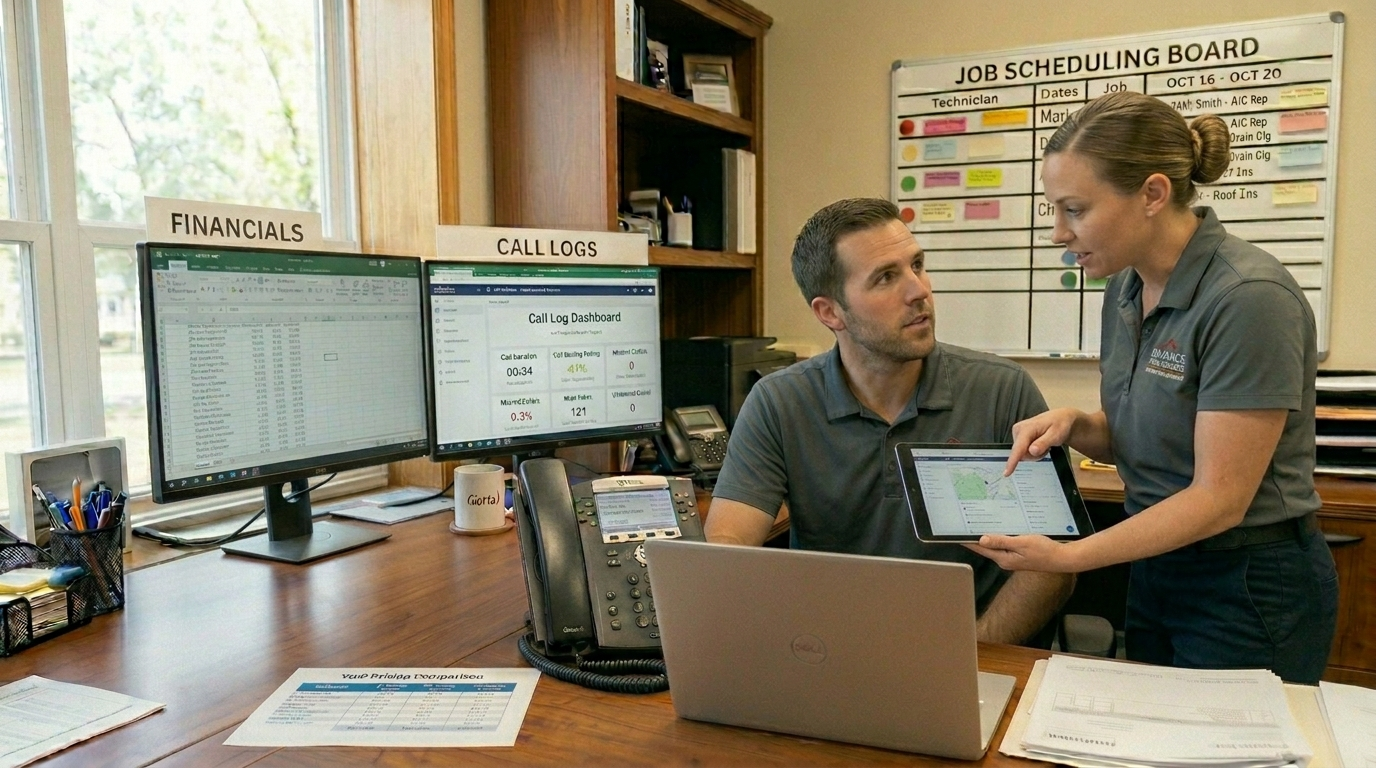
An AI receptionist enhances your existing phone system without expensive replacement. ### The Phone System That Was "Working Fine"
When Dave's HVAC company hit its eighth year in business, the operation looked solid on paper. Twelve trucks, a solid dispatcher team, and a phone setup that had been running without complaints for years. Two lines, a hold queue, and a voicemail box that got checked every morning. His service manager called it reliable.
His dispatcher called it manageable. Dave called it fine.
It was not until a slow January — after a brutal December where the phones should have been ringing off the hook — that Dave asked a question nobody had thought to ask: how many calls came in after 6 PM last month, and how many of them got answered? The answer from the call log was uncomfortable. Of the 94 inbound calls that came in outside office hours in December, 71 had gone to voicemail. Of those 71, there were 9 callbacks in the voicemail records.
The other 62 left nothing — no message, no contact information, no way to follow up.
December. Peak no-heat season. Sixty-two calls with no response, no record, and no recovery. The phone system was not broken.
But it was quietly bleeding revenue every single night.
The Wrong Question to Start With
Most contractors who start thinking about changing their call handling setup ask the same question first: do I have to replace my phone system? It is a reasonable operational concern. Ripping out infrastructure, retraining staff, migrating numbers, and disrupting a dispatch workflow that is already under pressure is not something any business owner wants to sign up for.
But it is the wrong first question — because the answer is almost always no, and the more important question is being skipped entirely.
The question worth asking is: what is your current phone setup actually doing for the 60% of high-intent calls that come in outside business hours? What happens to the qualified lead who calls at 9 PM on a Tuesday? What happens to the emergency plumbing call that comes in at 6:30 AM on a Saturday, before anyone is in the office? What happens to the roofing estimate request that hits the voicemail queue during a storm surge when your dispatcher is already on two other lines?
If the honest answer to any of those questions involves voicemail, the system is not working — regardless of how reliably the hardware runs.
What Replacement Actually Means in the Trades
The word "replacement" creates a mental image that stops most contractors from having this conversation at all. It implies disruption. Downtime. A rip-and-replace project that takes weeks, costs money upfront, and creates chaos in an operation that cannot afford chaos.
That is not what structured call handling in home services actually looks like in practice.
The transition model that produces results — and that the most effective contractors in HVAC, plumbing, electrical, and roofing are actually using — does not start with a full system replacement. It starts with identifying the specific gap where revenue is leaking and deploying a solution on that single channel first.
For most operations, that gap is after-hours inbound volume. The existing phone system, the existing dispatcher team, and the existing dispatch software stay exactly where they are. What changes is what happens when no one is available to answer — instead of voicemail, there is a live response. Instead of silence, there is a qualified intake, a captured lead, and a job booked directly into the existing workflow.
The phone number does not change. The dispatch software does not change. The dispatcher's role does not change. What changes is the outcome for the 60% of calls that were previously producing nothing.
The Transition Risk Is Not What Most Owners Think It Is
The fear most operators have about changing their call handling setup is a fear of disruption — of something going wrong during the transition that costs them jobs or creates confusion for customers. It is a legitimate concern in an industry where every call matters and margin for error is low.
But the actual risk profile of a phased, audit-first transition is almost the inverse of what most owners imagine. The risk is not in changing the setup. The risk is in keeping the status quo.
Research on consumer behavior in local service businesses consistently shows that customers who reach voicemail on an inbound call to a service company do not wait for a callback. The majority move on within minutes. In a market where competitors are one Google search away and urgency is the primary driver of the call, voicemail is not a fallback option — it is a lost job.
According to field service industry benchmarking data, home service businesses that operate with no structured after-hours call handling lose a measurable and consistent percentage of their weekly inbound leads to competitors who answer faster. The transition risk is not the disruption of changing the system. It is the ongoing, daily cost of not changing it.
A structured approach that deploys a focused solution on one channel, tests it against a real baseline, and measures the result before expanding eliminates the bulk of that transition risk. You are not betting the operation on a full rollout. You are running a controlled, two-week proof of concept that either produces results or does not — and the data tells you which.
What Your Dispatcher Actually Gains From This Transition
One of the most consistent findings in operations that have made this transition is that the dispatcher team — the group most likely to feel threatened by a change to call handling — ends up as the primary beneficiary.
When the after-hours and overflow call volume is handled outside the dispatcher's workload, the calls that land on their desk are the ones that actually require their expertise. Complex routing decisions. High-value customer conversations. Escalated jobs that need a skilled human to triage and prioritize.
The work that dispatchers are actually good at, and that the business actually needs them to do.
Studies on workload management in field service operations find that when skilled staff are relieved of repetitive, low-complexity tasks, both job satisfaction and output quality on high-complexity tasks improve. A dispatcher who is not spending the first two hours of their shift clearing an overnight voicemail backlog is a dispatcher who is present, focused, and effective when the 8 AM surge hits.
The transition is not a threat to your team. In the operations that have done it well, it is described by dispatchers themselves as relief — a removal of the low-value volume that was making the hardest parts of their job harder.
The Integration Question: Does It Work With What You Already Have?
For contractors running ServiceTitan or Housecall Pro, the integration concern is legitimate. These platforms are the operational backbone of mid-to-high volume home service businesses — job management, dispatch, invoicing, customer records. Any change to call handling that does not connect directly to those platforms creates manual work, data gaps, and the kind of friction that kills adoption.
This is precisely why the integration layer matters more than the call handling layer for most operators. A solution that captures a lead but does not push it into ServiceTitan or Housecall Pro has not solved the problem. It has created a parallel workflow that someone has to manage manually — which defeats the purpose entirely.
The right transition does not add a layer of work for your team. It removes one. Qualified calls are captured, triaged, and pushed directly into your existing dispatch workflow. Your dispatcher sees a new job entry, not a voicemail to decode and manually enter.
That is what a functional integration looks like in practice — and it is the standard against which any call handling transition should be measured.
The Audit That Makes the Transition Intelligent
The contractors who have the smoothest transitions — and the strongest results — are not the ones who move fastest. They are the ones who start with the right data.
A 30-day call audit before any deployment answers the questions that make the transition intelligent rather than speculative. Where is the inbound volume concentrated? What time windows are generating the most missed calls? What types of calls — emergencies, estimates, routine service — are being dropped?
What is the approximate job value of those calls?
That audit determines what gets deployed, where it gets deployed, and what a successful outcome looks like before anything goes live. It is the difference between a transition that produces measurable revenue within weeks and a rollout that generates activity without producing results.
This is how Enumsol's AI Voice Receptionists are deployed across home service operations. The process starts with the audit — real call data, real missed call patterns, real revenue exposure. A focused proof of concept follows on a single channel. Results are measured against the actual baseline.
Only what works gets expanded.
No broad rollout. No rip-and-replace. No disruption to the team or the workflow. Just a controlled, measurable fix for the specific gap that is costing the business money — deployed on top of the infrastructure that already exists.
Conclusion
The question of whether an AI receptionist can replace your current phone system is, in most cases, a question that does not need to be answered — because replacement is not the model. The phone system stays. The dispatch software stays. The team stays.
What changes is the outcome for the calls that are currently going unanswered.
Your current setup has a gap. It probably shows up after hours, during campaign surges, or on weekends. That gap has a dollar value — measurable from your own call logs, calculable from your own job averages — and it is producing nothing right now but missed revenue and wasted marketing spend.
The transition that fixes that gap does not require a system overhaul. It requires knowing exactly where the leak is, deploying a precise fix, and measuring the result. The real question is not whether you are ready to replace your phone system — it is how much longer you are willing to let the calls you already paid for go straight to voicemail?
Sources: Clutch SMB Technology Adoption Report; BrightLocal Local Services Consumer Survey; ServiceTitan Contractor Benchmarking Report; Aberdeen Group Field Service Research; CallRail Home Services Benchmarking Report; Salesforce State of Service Report.