
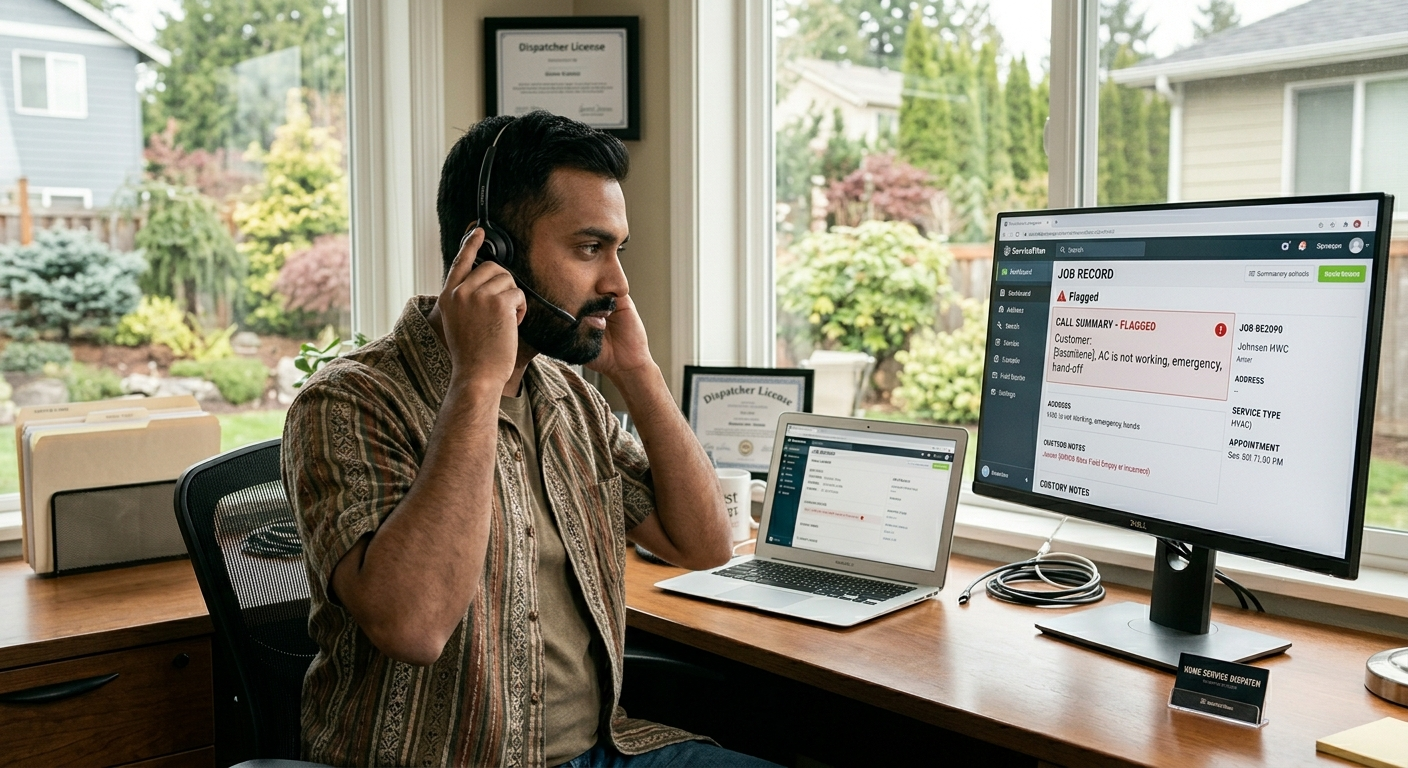
Smart AI call routing seamlessly transfers complex calls to human dispatchers when needed. ### The Emergency That Almost Got Dropped
It was a Wednesday afternoon in late August when Sandra called an HVAC company about her elderly mother's air conditioning unit. The system had stopped cooling entirely. Her mother was 78, had a heart condition, and the forecast called for a heat index above 100 degrees for the next three days. Sandra was not calling to schedule a tune-up.
She was calling with an emergency — and she needed to talk to a real person.
What picked up was an automated intake system. It gathered Sandra's name, her mother's address, and the nature of the call. It confirmed the service area. And then — before Sandra had the chance to explain the urgency of the medical situation — it did something that made the difference between a booked job and a furious online review: it recognized the call as a high-priority emergency, told Sandra clearly that she was being connected to a dispatcher immediately, and transferred the call live within 90 seconds.
The dispatcher who took over had Sandra's intake information already on screen. She did not ask Sandra to repeat herself. She escalated the job to same-day priority, confirmed an arrival window, and had a technician dispatched before the call ended. The job was booked.
Sandra left a review describing the company as the only contractor who treated the situation with the urgency it deserved.
The system did not try to handle everything. It handled what it was built for — and handed off the rest, fast, with the context the dispatcher needed to close the job.
The Question Behind the Question
When home service business owners ask whether an AI receptionist can transfer calls to a human, what they are really asking is: will my customers fall through the cracks? Will the complex calls, the emergencies, the high-value inquiries get handled the way they deserve — or will they get stuck in an automated loop with no way out?
It is the right concern. The value of any call handling setup in the trades is measured entirely by what happens to the jobs on the other end of those calls. A system that captures routine inquiries efficiently but fumbles the emergency dispatch is not solving the right problem. The emergency call — the one with the highest urgency, the most revenue at stake, and the customer most likely to leave a review — is exactly the call that needs to reach a human fast, with full context, and without making the customer repeat themselves.
The hybrid model — where structured call handling manages intake and volume, and live handoffs are triggered for specific call types — is not a compromise. For mid-to-high volume home service operations, it is the only model that makes operational sense. And the handoff is not an afterthought. It is the mechanism that makes the entire system work for the calls that matter most.
What a Functional Hybrid Workflow Actually Looks Like
In a well-designed hybrid call workflow for a home service business, the handoff logic is built around call type, not call volume. The system is not transferring calls randomly or based on caller frustration. It is identifying specific categories of calls — based on what the caller says and the urgency signals in the conversation — and routing them to the right person or the right queue with the right context attached.
An HVAC emergency at a property with a vulnerable occupant gets a live transfer to the on-call dispatcher immediately. A roofing estimate request after a storm gets captured, logged as high priority, and flagged for a callback within the hour. A routine tune-up inquiry gets booked directly into the dispatch software. A complex warranty question gets escalated with a note to the service manager.
Each of those outcomes is different. Each of them is the right outcome for that specific call type. And none of them require the dispatcher to be on the line for the initial intake — which means the dispatcher's time is preserved for the conversations that actually require their judgment.
Research on hybrid service workflows across customer-facing operations consistently finds that the most effective models are not the ones that maximize automation or maximize human involvement — they are the ones that route each interaction to the right resource based on the specific nature of the request. In home services, that principle translates directly into revenue: high-urgency calls handled fast by the right person, routine volume handled efficiently without burning dispatcher capacity, and every caller receiving a response that matches the stakes of their situation.
Why the Handoff Quality Matters as Much as the Handoff Speed
There are two ways a call transfer can go. In the first, the caller is transferred with no context — the dispatcher picks up, the customer has to repeat everything they already said, and the goodwill built during the initial intake immediately drains away. In the second, the dispatcher picks up with the caller's name, address, issue description, and urgency level already on screen — and the conversation picks up where the intake left off.
The difference between those two experiences is not just a customer satisfaction variable. It is a conversion variable. Research from customer experience studies across service industries consistently shows that customers who are asked to repeat information after a transfer report significantly lower satisfaction and are measurably less likely to complete a booking compared to customers whose information travels with the call.
In home services, where the caller is often stressed, in a hurry, and evaluating multiple contractors simultaneously, the warm handoff — context intact, no repetition required, dispatcher immediately up to speed — is not a courtesy. It is a competitive differentiator. The contractor whose dispatcher picks up already knowing what the problem is starts the high-value part of the conversation from a position of competence and trust. The contractor whose dispatcher opens with "can you tell me what's going on?" has already lost ground.
What This Does for Your Dispatcher's Day
The hybrid workflow does not just protect the customer experience on complex calls. It fundamentally changes what your dispatcher's day looks like — and what they are able to accomplish.
In a traditional setup, every inbound call regardless of complexity lands on the dispatcher's desk. Routine inquiries, appointment confirmations, service area questions, FAQ calls — all of it competes for the same attention as the genuine emergencies, the high-value estimate requests, and the complex routing decisions that only an experienced dispatcher can handle well.
Studies on workload distribution in field service operations consistently show that when skilled dispatchers are shielded from low-complexity call volume, their output on high-complexity tasks improves measurably. Response times on genuine emergencies decrease. Intake quality on high-value inquiries increases. And the dispatcher — freed from the grind of fielding every routine call — is more present and effective when the calls that actually require their expertise come through.
In practical terms: a dispatcher who handles 40 calls on a busy day, 25 of which are routine intake and FAQ calls, is operating at a significant fraction of their potential value. A dispatcher who handles 15 calls — all of them escalated, flagged, and pre-qualified — is operating at full capacity on the work that actually moves the business. The hybrid model does not reduce dispatcher value. It concentrates it where it produces the highest return.
The Calls That Should Always Reach a Human — and How to Define Them
One of the most important operational decisions in designing a hybrid workflow is defining — precisely — which call types should trigger a live transfer versus a callback flag versus a direct booking. This is not a technology decision. It is a business decision, and it requires knowing your operation well enough to articulate the difference between a call you can afford to schedule for follow-up and a call you need to handle right now.
For most home service businesses, the live transfer triggers fall into a small number of clear categories: genuine life-safety emergencies involving vulnerable occupants, active emergency situations where delay creates additional damage or risk, and high-value inquiries from commercial accounts or multi-unit properties where the relationship stakes are high enough to warrant immediate human engagement.
Everything outside those categories — routine service requests, standard estimate inquiries, appointment confirmations, general questions — can be handled through structured intake and callback scheduling without any loss of conversion rate. In fact, research on consumer expectations in service contexts shows that customers are comfortable with a structured callback commitment when the timeframe is clearly communicated and reliably honored. The standard they are holding you to is not "I need a human right now" — it is "I need to know someone is coming and when."
The audit that precedes any well-designed hybrid deployment maps those categories against your actual call history — identifying what share of your inbound volume falls into each bucket and designing the routing logic around your real call mix, not a generic template.
How Enumsol Builds the Handoff Into Every Deployment
This handoff architecture is central to how Enumsol's AI Voice Receptionists are deployed across home service operations. The live transfer capability, the callback escalation logic, and the context-with-the-call handoff are not optional add-ons. They are built into the deployment from the start — because a system that cannot get the right call to the right person at the right time is not solving the problem that matters.
Every deployment begins with a 30-day audit of your actual call data — identifying the specific call types that require live handling, the volume in each category, and the windows when live coverage is most critical. The hybrid workflow is then configured around that data, tested on a single channel against your real baseline, and refined until the transfer logic produces the outcomes your operation needs.
Your dispatcher does not learn new software. Your customers do not experience a different phone number. What changes is what happens to each call — routine volume handled efficiently, complex and urgent calls reaching the right person with full context, and no qualified lead falling through the gap between intake and follow-up.
Conclusion
The hybrid model is not a fallback for when the system cannot handle something. It is the design — a deliberate architecture that matches each call to the resource best equipped to convert it into a booked job. Routine intake handled efficiently without dispatcher involvement. Emergencies and high-value inquiries escalated fast, with context, to the person who can close them.
The businesses getting the most out of this model are not the ones trying to automate the most. They are the ones who are precise about what should reach a human and what should not — and who have built a handoff process reliable enough that when a call does escalate, the dispatcher has everything they need to take it across the finish line.
Every call your business receives is a customer who already decided to call you. The only question is whether the path from that first ring to a booked job is built well enough to actually get them there — so how confident are you in that path right now?
Sources: Forrester Research Customer Service Report; ICMI Contact Center Industry Research; Genesys State of Customer Experience Report; McKinsey Customer Care Insights; Hubspot State of Service Report; Aberdeen Group Field Service Research.