
For home service businesses, AI phone answering technology has become essential for growth. ### The Call at 2:14 AM
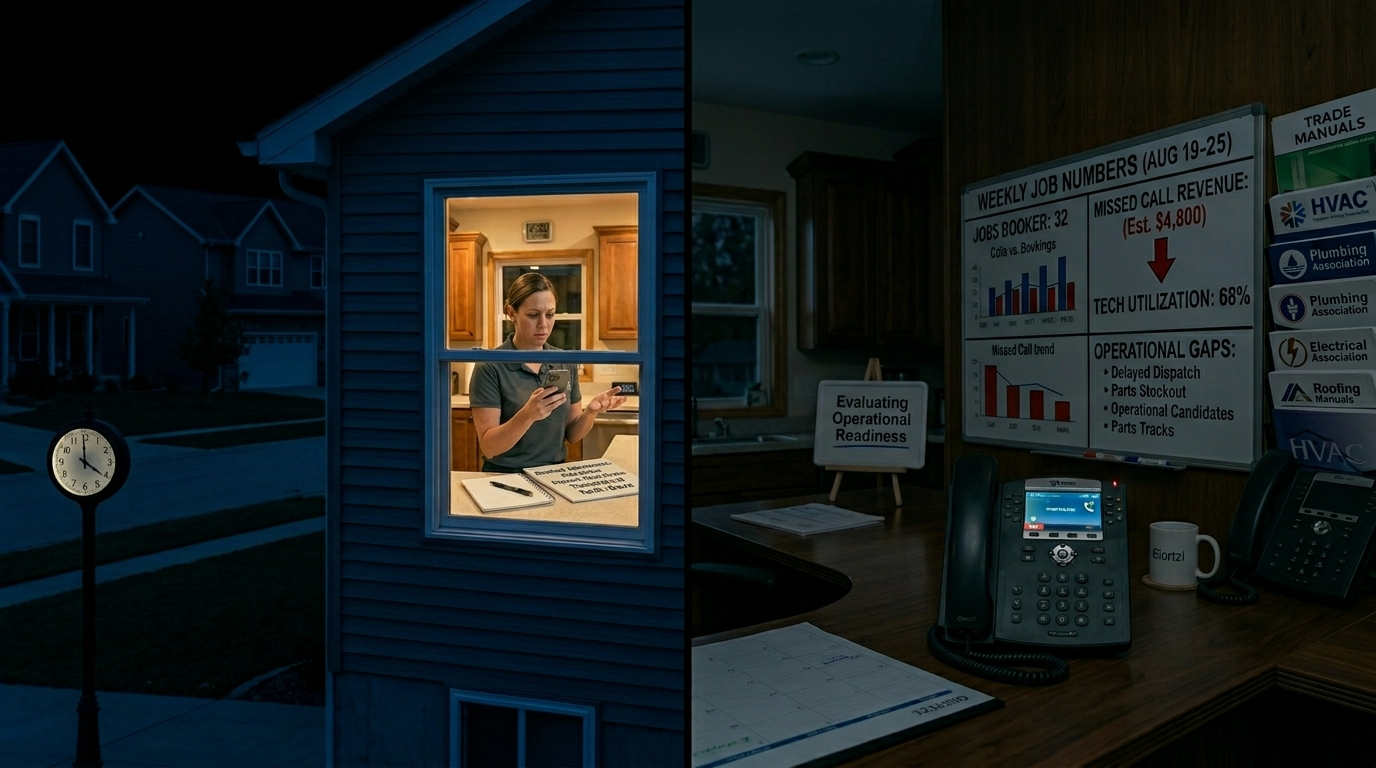
It was the middle of a January night when Gary woke up to the sound of running water — the kind that should not be running. A supply line behind his washing machine had given out. His basement was taking on water. He grabbed his phone and started searching for plumbers.
It was 2:14 AM.
He called four companies. One had a message that said to call back during business hours. Two went straight to voicemail. The fourth — a mid-sized plumbing operation he had never heard of before that night — picked up in under three seconds.
Gary had an appointment confirmed, an emergency dispatch flagged, and a technician on the way before 3 AM. The job was a $2,200 emergency repair. Gary left a five-star review. He referred two neighbors the following month.
The three companies that did not answer that night will never know Gary called. There is no missed call record that tells them what it cost. There is no entry in a CRM showing a job that went to a competitor. It just did not happen for them — quietly, invisibly, the way after-hours revenue losses always do.
The Hours When the Phone Actually Rings
There is a persistent assumption in home service operations that the bulk of meaningful inbound calls happen during business hours — and that after-hours coverage, while nice to have, is a secondary concern. The call data does not support that assumption.
Research tracking inbound call behavior across home service businesses consistently shows that a significant share of high-intent calls — calls from homeowners ready to book, not just browsing — arrive outside the standard 8 AM to 5 PM window. Evening hours, early mornings, weekends, and holidays account for a disproportionate share of emergency-category inbound calls specifically. These are the calls with the highest urgency, the highest conversion potential, and, in most operations, the lowest answer rate.
According to home services industry data, weekend and evening windows represent some of the highest-density periods for emergency inbound calls in HVAC, plumbing, and electrical categories. Heating systems do not fail on Wednesday mornings when the office is fully staffed. They fail on Friday nights, on Christmas Eve, and on the coldest Sunday of the year. Pipes burst at midnight.
Electrical panels trip on Saturday afternoons. Roof damage gets discovered on Sunday morning after the storm has passed.
The businesses answering those calls are booking those jobs. The businesses sending them to voicemail are funding their competitors' growth.
What "After Hours" Actually Costs Per Week
The financial case for 24/7 coverage is not theoretical. It is arithmetic — and it starts with your own call log.
Consider a mid-volume HVAC operation that generates 60 inbound calls per week from a mix of organic and paid sources. Research on home services call timing patterns suggests that a meaningful proportion of those calls arrive outside standard business hours. If 35% of inbound calls arrive after 5 PM or on weekends — a conservative estimate based on industry benchmarking — that is 21 calls per week arriving when most offices are dark.
If 80% of those after-hours callers reach voicemail and hang up without leaving a message, the operation is losing approximately 17 qualified inbound calls per week to no response. At an average job value of $900 across a mixed service call and replacement inquiry volume, that is more than $15,000 in weekly revenue exposure — before factoring in repeat business or referrals from customers who would have stayed loyal if they had been answered.
Over 52 weeks, that number exceeds $780,000 in annual revenue from leads that were already in the market, already calling in, and already gone before the office opened the next morning.
The cost of 24/7 coverage is a fraction of that exposure. The cost of not having it is the exposure itself.
The Human Staffing Alternative and Why It Does Not Scale
The obvious alternative to structured call handling for after-hours coverage is on-call human staffing. Put a dispatcher on call overnight. Have someone answer a forwarded line on weekends. Hire a part-time after-hours coordinator.
This model works at very small scale and breaks down quickly as volume increases. An on-call dispatcher handling a surge night during storm season or a peak holiday weekend is not providing coverage — they are managing one call at a time while the rest ring out. They are also burning out. Research on workforce management in field service businesses consistently identifies on-call scheduling as one of the primary drivers of dispatcher turnover — an expensive problem in an industry where experienced dispatchers are difficult to replace and critical to operations.
The labor economics of human after-hours coverage also compound over time. According to Bureau of Labor Statistics occupational data, dispatcher wages in home services contexts range from $18 to $28 per hour in most US markets. Overnight and weekend coverage at those rates, staffed consistently across 365 days per year, represents a significant fixed cost — one that still does not solve the parallel call problem during high-volume windows or guarantee consistent quality across every shift.
24/7 structured call handling addresses all three of those constraints simultaneously. It does not sleep. It does not get tired on a surge night. It handles simultaneous inbound calls without degradation in response time or intake quality.
And it does not generate turnover costs.
Holidays: The Window Nobody Staffs and Everyone Loses
If there is a single window that illustrates the cost of after-hours gaps most clearly in home services, it is the holiday calendar.
Thanksgiving is one of the highest-volume days of the year for residential plumbing calls — garbage disposals, kitchen drain clogs, and pipe issues from the combination of high household usage and cold weather moving in simultaneously. The Fourth of July and Labor Day generate significant HVAC emergency volume as systems run continuously in summer heat. Christmas and New Year's windows produce heating system failures at a rate that catches most HVAC contractors understaffed and underprepared.
These are not unpredictable surges. They happen every year, on the same dates, in the same categories. And every year, a portion of the inbound call volume they generate hits voicemail at operations that closed for the holiday — or hits an overwhelmed on-call line that cannot keep up with simultaneous demand.
The contractors capturing those jobs are not working harder. They are simply ensuring the phone gets answered on the days when their competitors have gone dark. That availability — consistent, reliable, 365 days per year — is a competitive advantage that compounds over time. Customers who were helped during a holiday emergency remember.
They come back for maintenance. They refer neighbors. They do not call anyone else.
What 24/7 Coverage Looks Like Across the Four Trades
The value of around-the-clock availability is not uniform across every home service category — it is shaped by the specific emergency patterns and seasonality of each trade.
In HVAC, the after-hours window is most valuable during the peak seasonal transitions — first cold snap, mid-summer heat waves, and the holiday windows when heating systems fail. These are the periods when competitors' after-hours gaps are widest and the customer's urgency is highest. The contractor who answers at 11 PM in January books the emergency service call. The contractor who answers at 9 PM in July books the emergency cooling repair.
After-hours coverage in HVAC is not a convenience feature — it is a seasonal revenue strategy.
In residential plumbing, emergency volume is more evenly distributed across the calendar because plumbing failures are less seasonal and more event-driven. Burst pipes, water heater failures, drain emergencies — these calls arrive on any night of any week. The plumbing operation with consistent 24/7 coverage captures a higher proportion of its market's emergency volume simply by being available when competitors are not.
In electrical services, after-hours coverage captures a specific and high-value call type: power outage and panel emergency calls that arise when homeowners discover an issue at the end of the day or during a storm event. These calls have high urgency and, in the case of panel upgrades and service work, high job values. Answering those calls after hours positions the contractor for a next-morning appointment that would otherwise go to whoever the homeowner reached first the following morning.
In roofing, the 24/7 window is most valuable in the 48 to 72 hours following a significant storm event — when homeowners are assessing damage, making decisions, and calling contractors before the surge has peaked. The roofing company answering calls at 10 PM after a hail event is booking estimates while competitors' phones ring out.
The Audit That Quantifies Your After-Hours Exposure
The most effective way to understand what 24/7 coverage is worth to your specific operation is to review 30 days of call log data broken down by time of day and day of week. This audit surfaces the exact windows where your inbound volume is arriving without an answer — and what that volume is worth based on your own job value averages.
This is the starting point for how Enumsol's AI Voice Receptionists are deployed. Before any coverage model is built, the call data is reviewed to identify exactly where the after-hours gaps exist and what they are costing. A focused proof of concept is then deployed on the highest-exposure window — tested against your actual baseline for two weeks before any broader rollout.
The goal is not to automate everything. It is to close the specific gap where the most revenue is currently leaking — consistently, every night, every weekend, every holiday — without adding headcount, without creating dispatcher burnout, and without sending another qualified lead to voicemail because the office happened to be closed.
Conclusion
The answer to whether an AI receptionist can work 24/7 is yes — but that is not actually the answer that matters most to your business. What matters is what your current setup is doing during the hours when 60% of your highest-intent calls are arriving. Whether your voicemail is capturing those leads or losing them. Whether your competitors are answering calls on Friday nights and holiday weekends while your line rings out.
24/7 availability is not a technology story. It is a revenue story. Every hour your phone goes unanswered is an hour your market is calling and your competitors are picking up. Every holiday your office closes is a window someone else is using to capture customers who would have called you first.
The leads are in the market around the clock — so the real question is, how many hours a day is your business actually open for them?
Sources: J.D. Power Home Services Customer Satisfaction Study; American Home Shield Home Emergency Trends Report; Bureau of Labor Statistics Occupational Employment Data; Nextdoor Local Services Usage Report; HomeAdvisor True Cost Report; PHCC Industry Research.