
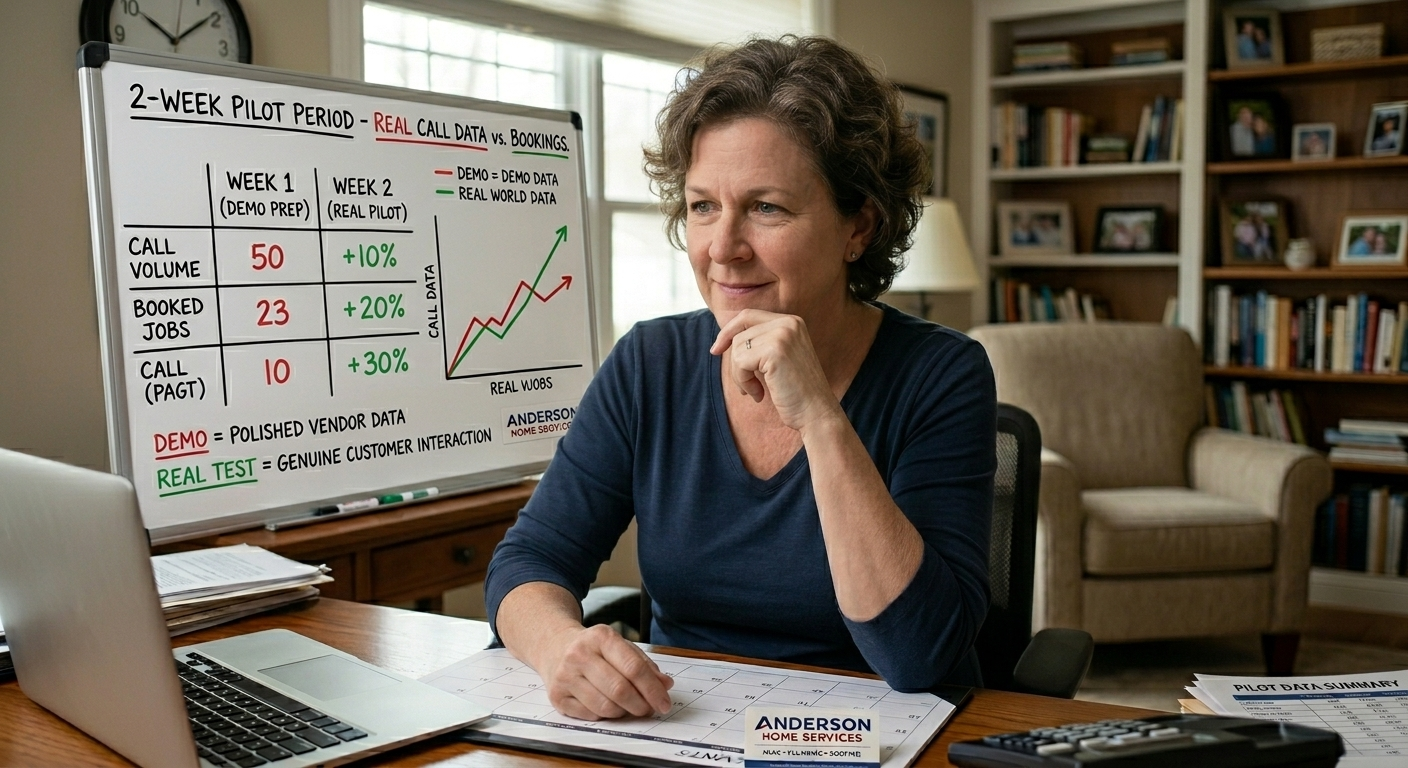
You can test an AI receptionist risk-free before committing to full deployment. ### The Demo That Looked Perfect
The sales call went smoothly. The screen share showed a clean interface, a confident voice, seamless booking flows, and a handful of impressive-looking metrics from other clients. The rep answered every question well. By the end of the call, the HVAC contractor on the other end of the line was genuinely interested — maybe the most interested he'd been in a vendor pitch in two years.
He signed up for the platform. The implementation took longer than expected. When it went live, the real-world performance looked nothing like the demo. The voice handling was stiff in situations the demo had never shown.
Edge cases — the callers who spoke quickly, the ones who gave partial addresses, the ones calling about warranty work on a system installed by a previous owner — produced outcomes the contractor had to manually clean up. Within sixty days, his dispatchers had stopped routing calls through the system entirely and gone back to answering manually.
He had paid three months of subscription fees for a demo that didn't survive contact with reality.
That experience is far more common in the home services technology space than vendors will tell you. And it is the precise reason that "can I test this before I commit" is not just a reasonable question — it is the right question, and the answer a vendor gives you tells you almost everything you need to know about whether their solution actually works.
The Difference Between a Demo and a Real Test
A demo is a controlled environment. It is designed to show a product performing well under conditions the vendor has selected, with scenarios the vendor has prepared for, and outcomes the vendor has already confirmed. That is not dishonest — it is just not a test. It is a presentation.
A real test is the opposite of controlled. It is your actual call volume, your actual service area, your actual callers — the ones who speak quickly, the ones who are frustrated, the ones calling at 11 p.m. about a system that stopped working two days ago. It is your dispatch platform, your booking workflow, your edge cases.
A solution that performs well in a demo but poorly in that environment has not been tested. It has been marketed.
For home service contractors evaluating any AI voice solution, this distinction is the most important filter to apply before any conversation about terms or pricing. The question is not whether a vendor will give you a trial period. It is whether the trial is structured to produce a genuine answer about performance in your specific operation — or whether it is simply an extended demo with a ticking clock.
What a Meaningful Pilot Actually Measures
A trial that is worth running has three components that cannot be skipped.
The first is a baseline. Before any solution goes live, you need a clear picture of your current performance — specifically, how many inbound calls you are receiving, what percentage are being answered, what percentage are converting to booked jobs, and what your after-hours call volume looks like relative to your staffed hours. Without that baseline, there is no way to measure whether the pilot produced a result. You are flying blind, and any improvement claimed by the vendor cannot be verified.
According to Invoca Research, 60% of high-intent calls to home service businesses arrive outside standard business hours — which means the after-hours window is almost always the single largest performance gap for any mid-volume operation. A pilot that does not specifically test performance in that window is not testing the most important variable.
The second component is a narrow scope. A pilot that attempts to replace every function of your front-of-house call handling all at once is too broad to produce a clean result. If ten things change simultaneously and results improve, you do not know which change drove the outcome. A meaningful pilot isolates one specific use case — after-hours coverage, overflow handling during a peak season surge, emergency call triage — and measures performance in that lane specifically.
The third is a defined success metric. Before the pilot begins, both parties should agree on what success looks like in concrete terms: call pickup rate, qualified leads generated, jobs booked. Not activity metrics like calls handled or average talk time — outcome metrics tied directly to revenue. If a vendor cannot define what success looks like in your operation before the pilot starts, the trial is not designed to produce a real answer.
Why the Audit Has to Come First
A pilot without an audit is a test without a starting point.
The audit phase — a structured review of thirty days of your existing call log data — is what makes the pilot meaningful. It identifies exactly where your calls are abandoning, which time windows carry the highest missed-call rate, and what the estimated revenue value of those gaps represents. This is not a process that takes months. It is a focused data review that produces a specific, dollar-grounded picture of the opportunity before a single change is made to your operation.
The audit also determines where the pilot should be focused. Not every gap in your call handling carries the same revenue weight. The audit tells you which one to test first — and that specificity is what allows the two-week pilot to produce a result clean enough to act on.
CallRail benchmarking data confirms that measurable improvements in call pickup rate and booking conversion surface quickly once coverage gaps are closed — often within the first week of a focused deployment. That speed of feedback is what makes a two-week pilot sufficient to produce a real answer. You do not need ninety days to know if the calls are being answered and the jobs are being booked. You need a clean baseline, a narrow scope, and enough call volume to produce a statistically meaningful result.
What to Do With the Pilot Results
At the end of the two-week pilot, you should have a specific, documentable answer to a specific, documentable question: did this produce more booked jobs in this time window than we were producing before?
If the answer is yes, the case for expansion is data-driven, not faith-based. You are not being asked to bet on a promise or trust a vendor's case studies. You are looking at your own call log, your own booking data, and your own revenue — and deciding whether to extend what demonstrably worked in a controlled test to additional channels or time windows.
If the answer is no — or if the result is unclear — nothing significant has changed in your operation. A properly scoped pilot does not disrupt your dispatch workflow. Your team handles what they always handle. The pilot runs alongside your existing operation, not instead of it.
The downside of a pilot that does not produce a result is minimal. The downside of committing to a full deployment before testing is everything that contractor who sat through the perfect demo eventually learned the hard way.
This is the structure Enumsol's AI Voice Receptionists are deployed through — not because it is the easiest model to manage, but because it is the only model that produces results a business owner can actually trust. The audit defines the opportunity. The pilot proves the concept. Everything that follows is justified by what the numbers showed, not what a demo promised.
Conclusion
The home service contractors who get the most out of any new operational solution are not the ones who move fastest — they are the ones who insist on testing against reality before committing to scale. A two-week pilot grounded in a real audit, scoped to a single use case, and measured against a documented baseline is not a compromise between speed and caution. It is the most direct path to a confident, revenue-backed decision.
The question worth asking any vendor before you agree to anything is simple: can you show me results in my operation, with my call data, before I commit and if not, why not?
Sources: The data referenced in this article is drawn from the following sources: Invoca Research on after-hours inbound call volume and high-intent call behavior in home service businesses; and the CallRail Benchmarking Report on speed of measurable improvement following call coverage gap closures in local service operations.