
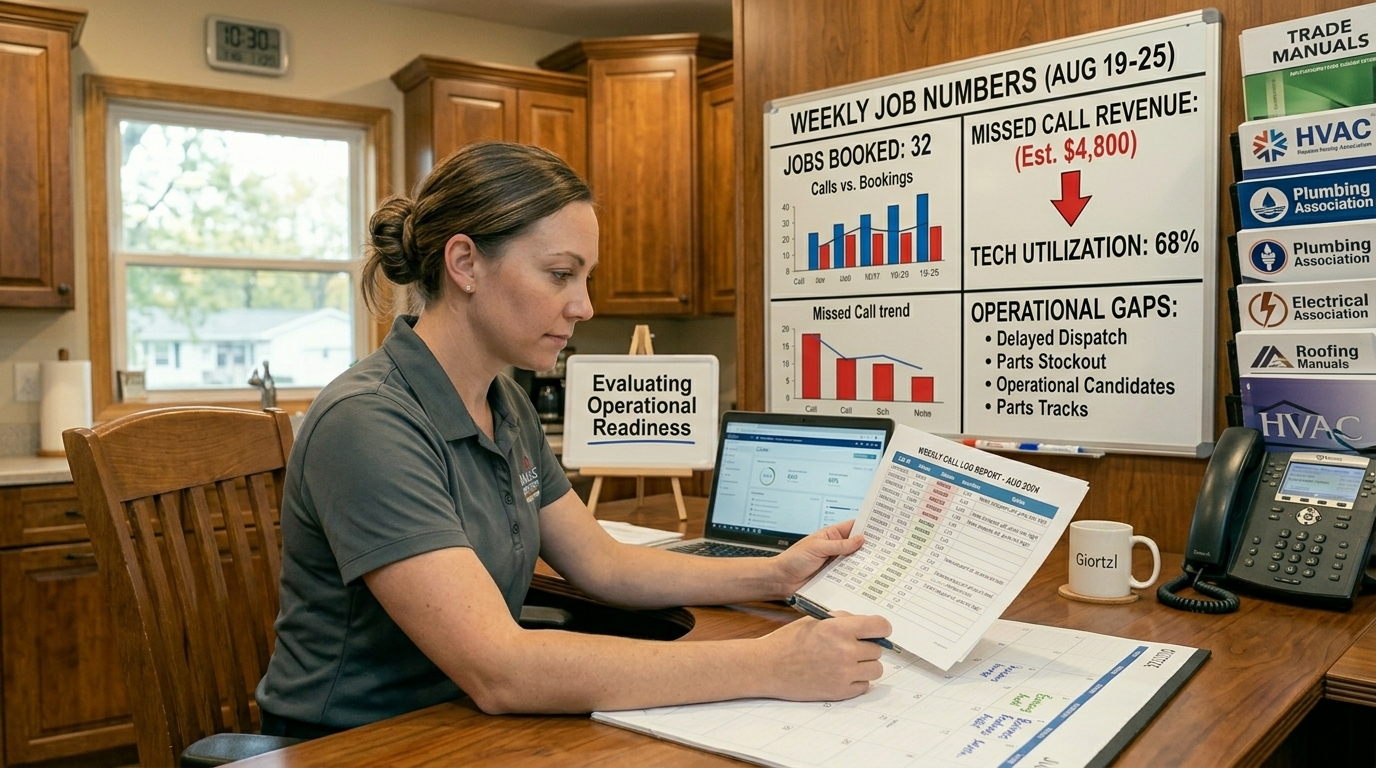
Five clear signals tell you if an AI receptionist is right for your home service business. ### The Owner Who Almost Talked Himself Out of It
Tom runs a residential electrical company in the Mid-Atlantic. Four trucks, a solid dispatcher, and a Google Ads account that his marketing agency described as one of their better-performing campaigns. When someone suggested he look into structured call handling for after-hours inbound volume, Tom's first reaction was skepticism. "We're not big enough to need that," he said.
"And our customers expect a real person."
Two weeks later, his dispatcher pulled 30 days of call log data as part of a routine review. What she found was not what either of them expected. Of the 118 inbound calls that came in outside office hours over that month, 91 went to voicemail. Of those 91, fewer than 10 resulted in a confirmed callback.
The rest — calls from homeowners with panel issues, breaker problems, and EV charger installation inquiries — had disappeared. No record, no follow-up, no revenue.
Tom's business was not too small for structured call handling. It was exactly the right size to be bleeding quietly and not knowing it. The question was never whether the solution was right for businesses like his. It was whether he had looked closely enough at his own operation to see what was already happening.
The Real Question Underneath the Question
"Is an AI receptionist right for my business?" is the surface question. The question underneath it is: am I currently losing revenue that I have not measured and cannot see?
For most mid-volume home service operations — HVAC contractors, residential plumbers, electrical companies, roofing businesses — the answer to that second question is yes. The revenue leak is real, it is consistent, and it is quantifiable. The only reason most owners do not know the size of it is that nobody has sat down and counted it yet.
The fit assessment for structured call handling is not a technology checklist. It is an operational one. The indicators that tell you this is the right move are not about your software stack or your team size. They are about the specific ways your business is currently generating and then losing qualified revenue — and whether closing those gaps is worth more than leaving them open.
Here are the five signals that consistently appear in the operations where structured call handling produces the clearest and fastest results.
Signal One: You Are Running Marketing Spend but Do Not Know Your Call Pickup Rate
If you are spending money on Google Ads, local service ads, SEO, or any other channel that drives inbound phone calls — and you do not know what percentage of those calls are actually being answered — you are flying blind on one of the most important metrics in your business.
According to home services industry research, the average contractor investing in paid digital advertising generates a meaningful volume of inbound phone calls per month depending on their market and budget. The cost per inbound call lead in trades categories ranges significantly by market and channel. But in nearly every case, a portion of those paid leads goes unanswered — and in most operations, that portion is larger than the owner realizes.
The marketing agency optimizes the ad. The SEO firm improves the ranking. But nobody is measuring what happens to the call after it comes in. If you cannot answer the question "what percentage of my inbound calls from paid campaigns are being answered live" — that gap alone is a strong signal that structured call handling belongs in your operation.
The audit that answers this question takes about two weeks of call log review. The number it produces is usually the moment the conversation about fit stops being hypothetical.
Signal Two: Your Phones Go to Voicemail After Business Hours
This one sounds obvious, but it is worth stating plainly: if your phone goes to voicemail after 5 PM, on weekends, or during holidays, you are missing a significant portion of your highest-intent inbound calls.
Research on consumer call behavior in local service businesses consistently shows that inbound call volume does not track with office hours. Homeowners call when they have a problem — and problems do not schedule themselves around business hours. Heating systems fail at night. Pipes burst on Sunday mornings.
Storm damage gets assessed on Saturday afternoons when homeowners finally get home and see what happened.
According to local services industry data, a substantial share of inbound calls to home service businesses occur in evening and weekend windows — precisely the windows where most operations default to voicemail. And based on consumer call behavior research, the majority of those callers do not leave a message. They call the next contractor.
The fit signal here is not complicated. If your after-hours calls go to voicemail and your competitors are answering, you are losing jobs you paid to generate. The only variable is how many — and that is a number your call logs can tell you in 30 days.
Signal Three: Your Dispatchers Are Consistently Stretched During Peak Periods
Dispatcher overload is one of the clearest operational signals that structured call handling belongs in a business — and it is also one of the most underreported, because stretched dispatchers rarely flag the problem to ownership. They handle it. They push through it. And the calls that slip through the cracks during the push do not generate a complaint — they just disappear.
Research on field service workforce capacity consistently finds that dispatchers operating at or above their handling capacity during peak periods produce lower quality intake on inbound calls, slower response times on high-priority requests, and higher rates of lead loss during surges. In practical terms: during a heat wave, a storm window, or a marketing push, the calls most likely to be mishandled or dropped entirely are the qualified, high-value ones that required more than a 60-second intake.
If your dispatchers are routinely fielding more calls than they can handle comfortably during busy periods — seasonal surges, campaign launches, Monday mornings after a bad weather weekend — your operation is structurally exposed during exactly the windows that generate your highest-value inbound volume. That is a fit signal.
Signal Four: You Use Job Management Software and Think in Truck Rolls
This signal is about operational maturity, not technology enthusiasm. Contractors running ServiceTitan or Housecall Pro have made a deliberate choice to run their operation with discipline — job tracking, dispatch management, customer records, invoicing. That level of organization is a prerequisite for structured call handling to work the way it should.
The reason is integration. A call handling solution that captures a lead but does not push it into your dispatch workflow creates manual work — a parallel system that someone has to manage, a data gap that produces errors, a process that breaks down under pressure. A solution that integrates natively with your existing software means qualified calls flow directly into the same system your dispatcher already uses. No new process.
No manual entry. Just more jobs appearing in the queue with complete intake information.
Contractors who think in terms of truck rolls, job value, and booked revenue — rather than software features and dashboards — are the operators who get the most out of structured call handling. Because they are measuring the right thing. The question they ask is not "what does the platform do?" It is "how many more jobs did we book this month?" That is the right frame — and it is the frame that produces the clearest ROI from this kind of operational change.
Signal Five: You Know Your Average Job Value and You Know It Is High Enough to Matter
The final fit signal is the one that closes the business case. Structured call handling produces its clearest return in businesses where the average job value is high enough that a single captured call more than justifies the operational investment.
In HVAC, plumbing, electrical, and roofing, job values range from a few hundred dollars for a basic service call to tens of thousands for a full system replacement or storm restoration project. According to home services industry benchmarking data, the average inbound call in trades categories represents significant potential revenue — and the cost of missing that call, multiplied across a week or a month, produces numbers that make the fit conversation straightforward.
If your average job is worth $1,500 and you are missing eight qualified calls per week, that is $12,000 in weekly revenue exposure. If your average job is worth $8,000 and you are missing three qualified estimate requests per week, the math is even starker. The point is not the specific numbers — it is whether you know yours, and whether you have done the calculation of what a missed call costs your business in concrete dollar terms.
Businesses where that calculation produces a number that is larger than any operational investment they are considering already know the answer to the fit question. They just have not run the math yet.
The Audit Is the Assessment
The five signals above are indicators, not verdicts. The only way to know with precision whether your operation is the right fit — and what the specific revenue opportunity looks like — is to look at your actual data.
A 30-day call audit is where the fit conversation becomes concrete. It takes the abstract question of "is this right for my business?" and turns it into a specific answer backed by your own numbers: how many calls came in, when they came in, how many were missed, and what those calls were worth. That data produces a revenue exposure figure that either justifies moving forward or tells you the gap is smaller than expected. Either answer is useful.
Neither requires guessing.
This is the starting point for how Enumsol's AI Voice Receptionists are deployed. Before any solution is built, the call data is reviewed, the gaps are identified, and a focused proof of concept is tested on a single channel against your actual baseline. You do not commit to a full rollout. You commit to a controlled test — and the results tell you everything you need to know about fit.
The businesses that benefit most from this process are not the largest or the most technically sophisticated. They are the ones willing to look honestly at their call logs and ask what the numbers actually show.
Conclusion
The fit question for structured call handling in home services almost always resolves itself the same way: not through a features comparison or a technology evaluation, but through a 30-day look at what the phone is actually doing. How many calls came in. How many were answered. How many went to voicemail and never came back.
What those calls were worth.
For most mid-volume HVAC, plumbing, electrical, and roofing operations, that look produces a number that makes the answer obvious. The leads were already in the market. The marketing dollars were already spent. The only gap was at the phone — and the only question left is how long it has been open.
So before deciding whether structured call handling is right for your business — when did you last count how many calls your business missed this month?
Sources: Angi Pro Insights Home Services Industry Report; Podium State of Local Business Report; SCORE Small Business Operational Benchmarks; Hatch Home Services Industry Benchmark Report; Local Search Association / Borrell Associates Home Services Call Volume Data; NFIB Small Business Economic Trends Report.