
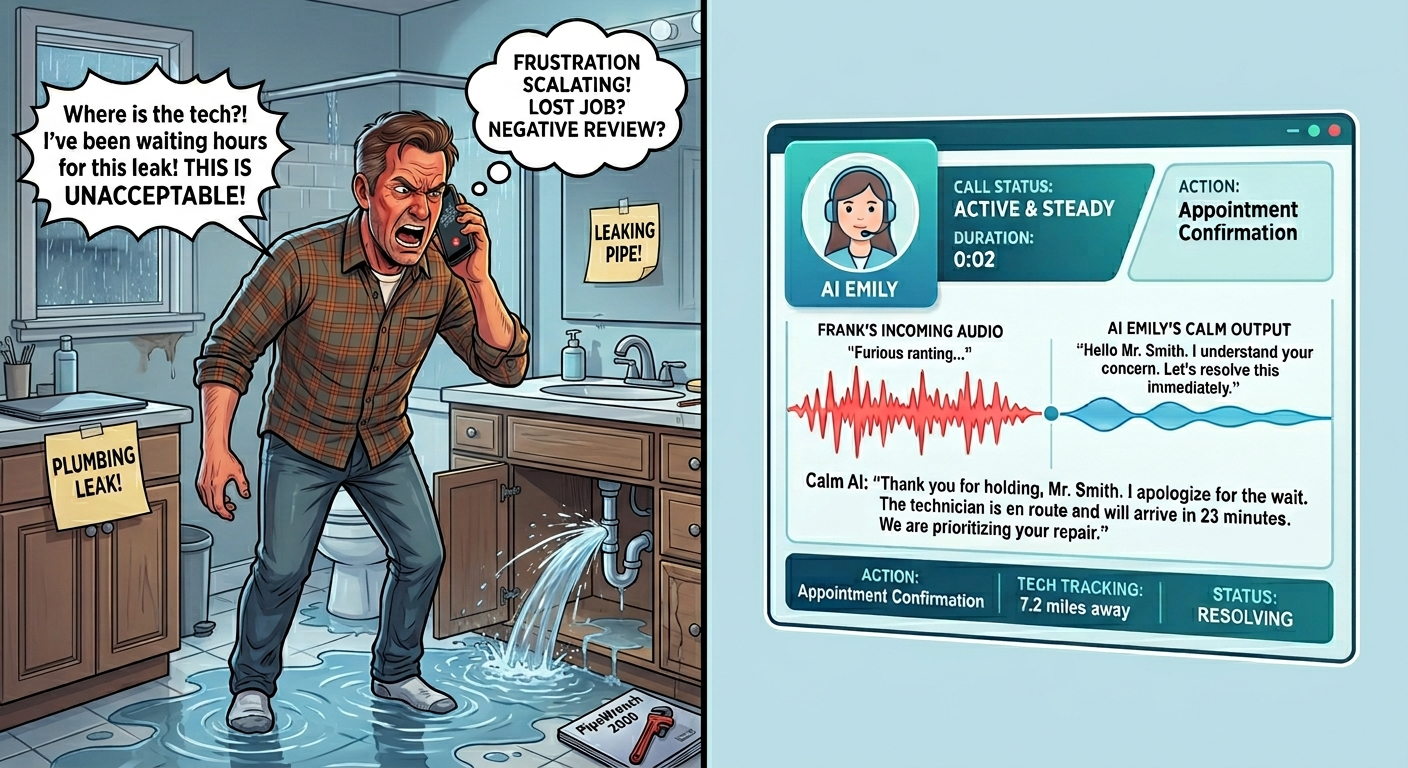
A professional AI receptionist handles difficult callers with consistent calm and efficiency. ### The Call That Ended With a One-Star Review
It was a Friday afternoon in late July. The phones had been ringing since 7 a.m. — a heat wave had pushed a week's worth of HVAC calls into two days, and both dispatchers were already running on fumes by noon. When the call came in at 4:47 p.m., the dispatcher answered it the way anyone answers a phone after eight hours of back-to-back calls: tired, slightly clipped, and not quite ready for what was on the other end.
The customer — a homeowner whose AC had been out since Thursday, with a baby in the house — had already called twice and been put on hold both times. By the third call she wasn't looking for empathy. She was furious. The dispatcher, already stretched, responded to her frustration with impatience.
The call ended with no appointment booked and a customer who felt dismissed.
The one-star review went up that evening. By Monday morning, the owner had three missed calls from people who had read it over the weekend and decided to call someone else.
Nobody on that team did anything malicious. The dispatcher was doing his best under impossible conditions. But the outcome — a lost job, a public review, and three more leads who never converted — was entirely real. And entirely preventable.
Angry Callers Are Not the Problem. How They're Handled Is.
It is worth being direct about something that often gets lost in the conversation about difficult callers: an angry customer who picks up the phone and calls your business is still a customer who wants to hire you.
The frustration is almost never about your company specifically — it is about the situation. A flooded basement, a failed AC unit during a heat advisory, an electrical issue that has half the house without power. These are stressful, urgent, sometimes frightening events. The person calling is not in a neutral state.
They are scared, inconvenienced, and acutely aware that they are dependent on someone else to fix something they cannot fix themselves.
That emotional context is exactly why the first thirty seconds of the call matter so much. A customer in distress who is answered immediately, heard without interruption, and moved efficiently toward a resolution does not stay angry for long. A customer in distress who is placed on hold, transferred twice, or met with impatience escalates — and that escalation rarely ends with a booked job.
According to Harvard Business Review research on customer experience and service recovery, customers who have a complaint resolved quickly and effectively are often more loyal than customers who never had a problem in the first place. The difficult call is not a liability. It is an opportunity — one that most home service businesses are currently equipped to miss.
The Real Cost of a Poorly Handled Difficult Call
The damage from a mishandled difficult caller rarely stops at a single lost job.
A one-star review on Google from a frustrated customer who felt dismissed does not disappear after a week. It sits on your profile and influences every prospective customer who searches your business name. For home service contractors who depend on local search visibility and review scores to generate inbound call volume, a single high-visibility negative review can suppress conversion rates across every channel.
CustomerFlows Home Service Business Statistics 2026 data indicates that the majority of homeowners consult online reviews before contacting a home service provider for the first time, and that a pattern of negative reviews — even a small number relative to total volume — has a measurable suppressive effect on inbound call volume. The mishandled call that generates that review is not a one-job loss. It is a compounding revenue problem that compounds silently, call by call, over weeks and months.
And the source of the problem is not bad people. It is a structural mismatch between the emotional demands of difficult call handling and the realistic capacity of a human dispatch team that is already managing high call volume, complex routing decisions, and the pressure of a full dispatch board.
Why Consistency Is the Core of Conflict Resolution
The most important thing a caller in distress needs from the person or system that answers their call is not a perfect script. It is consistent, calm, immediate engagement — every single time, regardless of what else is happening on the floor.
That consistency is the hardest thing for a human team to deliver under volume pressure. A dispatcher who has handled forty calls that day, managed three escalations, and is watching the hold queue grow is not operating at the same emotional baseline as a dispatcher on a quiet Tuesday morning. That variability is human and understandable — but it is also the reason difficult calls produce unpredictable outcomes.
An AI receptionist does not have bad days. It does not answer the forty-first call of the day differently from the first. It does not respond to a customer's frustration with impatience because it is tired. It answers every call in under two seconds, at the same consistent standard, regardless of call volume or time of day.
For a caller who is already in a heightened emotional state, that immediate, steady response — the signal that someone is there, paying attention, and moving toward a resolution — is often enough to shift the tone of the call before the first thirty seconds are over.
This is where Enumsol's AI Voice Receptionists create a structural advantage that no staffing solution can fully replicate. During peak season surges, storm-driven call floods, and the kind of multi-day heat waves that push an HVAC operation to its absolute limit, the call answer standard does not degrade. Every caller — including the angry ones — receives the same immediate, professional response. The difficult call doesn't slip through to a burned-out dispatcher at 4:47 on a Friday.
It gets handled.
What Happens When a Call Genuinely Needs a Human
Not every difficult caller can be fully resolved without human involvement. A caller with a complex dispute, a repeat complaint, or a situation that requires real-time judgment and empathy from a person who knows the account is best served by being connected to the right member of your team — quickly, with context already captured.
The value of a well-configured AI receptionist in these situations is not that it replaces the human resolution. It is that it ensures the call reaches the right human faster, with the relevant information already documented, rather than arriving as a cold transfer with no context. The dispatcher receiving that escalation is not starting from zero. They know who is calling, what the issue is, and what was already communicated — which means the human part of the resolution can focus on solving the problem rather than gathering information the caller has already had to repeat twice.
Enumsol's AI Voice Receptionists are built with exactly this escalation logic as part of the core deployment — because the goal is not to handle every call in isolation but to ensure that every call, including the hardest ones, moves toward the best possible outcome for the customer and for the business.
Conclusion
Difficult callers are not an edge case in home services — they are a regular feature of any operation running high call volume through an HVAC, plumbing, electrical, or roofing business. The customers who call angry are, in almost every case, customers who still want to hire you. The outcome of that call — whether it becomes a booked job and a loyal customer or a lost lead and a public review — is determined almost entirely by how it is answered, how quickly, and how consistently.
The question is not whether your operation will receive difficult calls. It is whether the system handling those calls is built to turn them into revenue — or whether that's still being left to whoever happens to pick up the phone on a Friday afternoon at the end of a very long week?
Sources: Harvard Business Review research on customer experience, service recovery, and the loyalty impact of resolved complaints; and CustomerFlows Home Service Business Statistics 2026 on the influence of online reviews on inbound call volume and conversion behavior in home service businesses.