
How Often Does an AI Receptionist Need Updates? What Home Service Contractors Need to Know Before They Buy
Carlos runs a roofing company in South Florida. Good operation — growing steadily, had just expanded into two new counties after three years of building the business. He'd deployed an AI call system six months earlier and had been happy with it. Pickup rate was up.
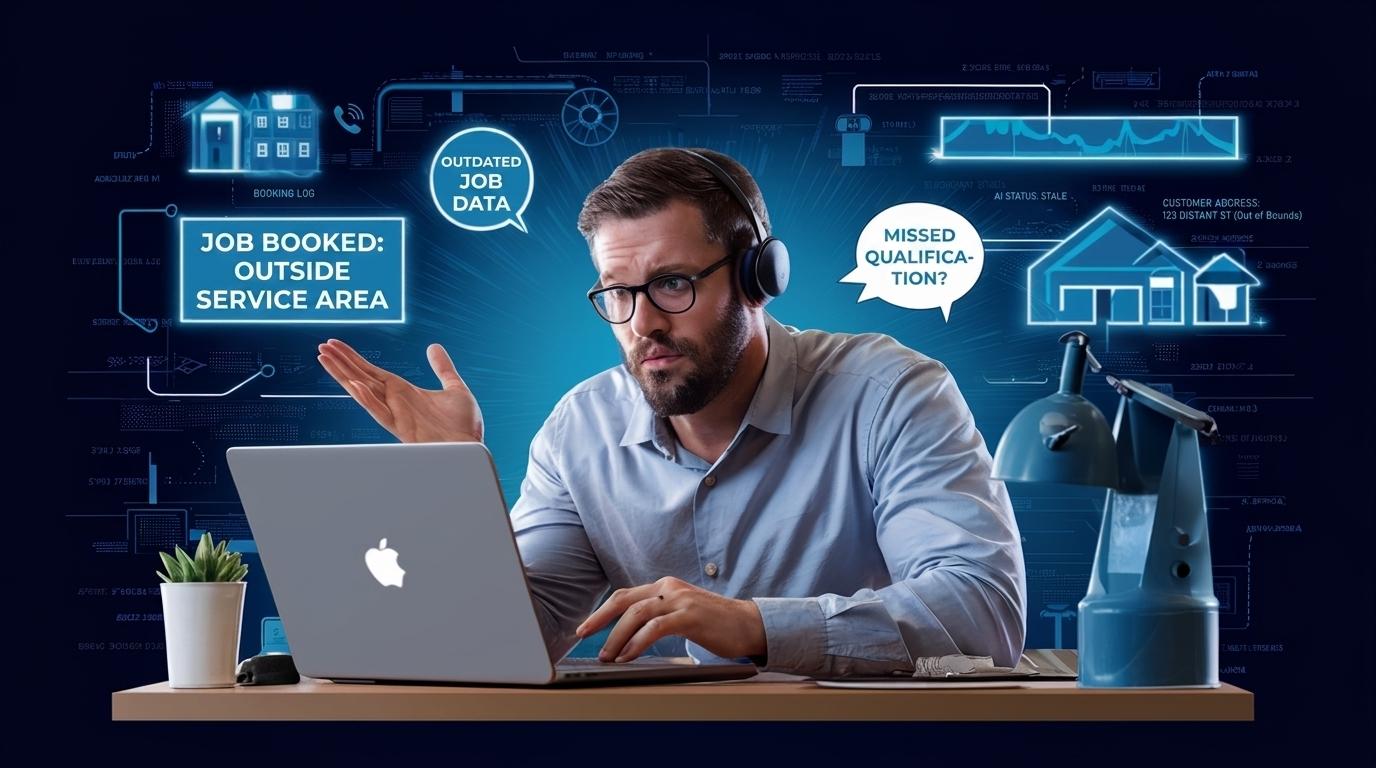
After-hours calls were getting answered. He considered it a solved problem and moved on to focusing on the expansion. Then, during the first major storm response of the season, his dispatcher started seeing something strange in the job queue: bookings from zip codes in the new service area that the AI was refusing to qualify. Homeowners calling with storm damage — $8,000 to $30,000 jobs — were being told his company didn't service their area and ending the call.
The system hadn't been updated with the expanded service area. It was still running on the configuration from six months ago, diligently turning away the exact jobs the expansion was meant to capture. Carlos had spent real money on marketing in those new counties. The calls were coming in.
And the AI was turning them away on his behalf, politely, every time. That is what "set it and forget it" actually costs a home service business.
The Short Answer — and Why the Full Answer Matters More
Yes, an AI receptionist needs regular updates. How often depends on what changes in your business — and in a home service operation, things change more often than most operators realize until something goes wrong.
The more important question isn't "how often does it need updates?" It's: who owns the responsibility of making those updates, and what happens to your revenue in the windows when the system doesn't reflect your current operation?
Because the contractor who deploys an AI system and walks away is not running a 24/7 call operation. They're running a 24/7 call operation that's slowly drifting away from their actual business — and that drift shows up as misrouted calls, incorrectly booked jobs, missed urgency signals, and lost revenue that nobody has tracked because it happened silently.
Why Home Service Businesses Need More Frequent Alignment Than Other Industries
A law firm's call handling changes infrequently. A yoga studio's scheduling logic is relatively static. A home service business is different — because the operation itself is in constant motion.
Service areas expand or contract as you add trucks, hire technicians, or make strategic decisions about coverage zones. Pricing changes with material costs, labor rates, and competitive pressure. Seasonal protocols shift dramatically — what counts as an emergency dispatch in February looks different from what counts in August. New services get added: EV charger installations, ductless mini-split systems, trenchless sewer repair.
Existing services get paused or discontinued. On-call technician rotations change. Dispatch protocols evolve as the team grows.
Every one of these changes is invisible to an AI system that hasn't been updated to reflect it. The system continues operating on its last known configuration — confidently, continuously, 24 hours a day — making decisions based on a version of your business that may no longer exist.
Research from Boston Consulting Group found that 74% of organizations struggle to generate tangible value from AI investments — not because the technology fails, but because of an organizational and process maintenance gap. Companies that successfully generate consistent ROI from AI systems invest twice as much in ongoing refinement and operational alignment as those that struggle. That finding holds especially true for home service operations, where the call handling requirements shift with the seasons, the weather, and the scope of work.
The Six Business Changes That Break an AI Receptionist Fastest
Not all business changes affect call handling equally. For a home service operation, these six create the most expensive drift when the AI hasn't been updated:
Service area changes. Adding zip codes, pulling back from zip codes, or adjusting geographic coverage is one of the most common and most damaging configuration gaps. The system will continue applying the old boundaries — booking jobs outside your coverage, refusing jobs inside it, or routing incorrectly between technicians — until it's updated. Carlos's story isn't unusual. It's the predictable outcome of a service area change that didn't trigger a system update.
Seasonal script and urgency logic changes. What constitutes an emergency in a plumbing business shifts between seasons. "Low water pressure" is a different level of urgency in January, when frozen pipes are a real possibility in your market, versus July. Emergency dispatch protocols for HVAC shift between heating and cooling seasons. An AI that hasn't been updated with seasonal urgency logic will triage calls using the wrong framework — and during a peak season surge, those misrouted calls are your highest-value revenue events.
New service offerings. When a contractor adds EV charger installations, whole-home generator service, or spray foam insulation to their menu, callers who inquire about those services need to be recognized and routed correctly. A system that doesn't know the new service exists will fumble those calls — at best passing them to a dispatcher who has to explain the gap, at worst leaving the caller with the impression that the company doesn't offer it.
Pricing and estimate range changes. If your system is configured to quote a typical service call range and your pricing has moved — due to material costs, labor adjustments, or competitive repositioning — callers are getting inaccurate information that either undersells your value or creates friction when the invoice doesn't match expectations.
On-call and escalation protocol changes. Emergency escalation paths need to reflect who's actually on call. An AI routing urgent calls to a technician who's no longer on the rotation, or failing to escalate because the on-call coverage structure changed, creates real operational problems — especially when a homeowner with a burst pipe at midnight reaches a number that's no longer staffed.
Dispatcher workflow changes. As your team grows, transitions, or reorganizes, the logic of how calls should be handled — when to route to whom, what information to collect before handoff, how to flag complex jobs for senior dispatchers — needs to reflect the current structure. A system configured for a three-dispatcher operation behaves incorrectly in a one-dispatcher environment, and vice versa.
The Self-Serve Trap: Who's Responsible When the System Drifts?
Here's the maintenance reality that most contractors don't think through before deploying a self-serve AI tool: the responsibility for keeping the system current falls entirely on whoever deployed it.
For a home service business owner or ops manager who is already managing technicians, dispatch, marketing, customer relationships, and business development, "updating the AI receptionist configuration" is one task too many. It gets postponed when things are busy — which is precisely when the system is handling the most volume. It gets forgotten when things are calm — which is often when the business is changing most rapidly, adding capacity, or repositioning.
The result is predictable: the system runs on stale configuration, and the gap between what it believes about the business and what the business actually is widens over time. Full optimization for a newly deployed AI system takes two to four weeks as the system trains on real call patterns and terminology. Without ongoing refinement beyond that initial calibration window, that optimization ceiling is permanent.
The distinction that matters most when evaluating any AI call solution is not the feature set — it's who owns the ongoing alignment work after the system goes live. A self-serve tool hands that responsibility to the operator. A managed service retains it. For a contractor who thinks in terms of truck rolls and job value, not software configuration, that distinction is the difference between a system that drifts and one that gets better.
How Often Updates Actually Need to Happen
The update frequency varies by what's changing in the business, but for a mid-volume home service operation running marketing spend and operating across multiple trades or service areas, a practical framework looks like this:
Seasonal transitions — at minimum twice a year. Before cooling season begins and before heating season begins, urgency logic, emergency dispatch protocols, and seasonal script variations should be reviewed and updated. These transitions are predictable, and the cost of entering a peak season on stale configuration is concentrated at exactly the highest-revenue window.
After any service area change — immediately. There's no good reason to wait on a service area update. Every day the system runs with incorrect geographic boundaries is a day it's either turning away qualified jobs or booking jobs that will create operational problems.
After pricing or service line changes — within the same week. Callers who receive outdated pricing information create friction at booking and at invoice. A week of misaligned quotes is a week of preventable customer service issues.
After staffing or dispatch structure changes — before the next shift. Escalation routing that's connected to the wrong person creates operational chaos during the highest-urgency calls — exactly where the stakes of a routing error are highest.
Ongoing call quality monitoring — continuously. Beyond specific business events, the highest-performing AI call operations treat the system as something that should be actively monitored, not passively deployed. Call outcomes — which calls converted, which didn't, where callers dropped off, which job types produced booking errors — are the ongoing signal for refinement. Contractors who treat AI like a tool that needs tuning every 60 to 90 days consistently outperform those who deploy once and walk away.
What Ongoing Optimization Produces — Beyond Error Prevention
The update conversation is usually framed around preventing drift — keeping the system from getting worse as the business changes. But there's a second, more positive argument for ongoing optimization: the system should be getting better over time, not just staying current.
Every real call the system handles is data. Which call types produce the highest booking rates? Which urgency signals are the most reliable predictors of high-ticket jobs? Which service area zip codes produce the most emergency call volume, and what's the optimal routing logic for them?
Which call times produce the most overflow, and how should coverage logic adapt to them?
A system that's actively monitored and refined against this data improves its qualification accuracy, its booking rate, and its emergency triage precision with every optimization cycle. The 58% increase in after-hours booked jobs that a well-managed deployment produces isn't a function of the initial configuration — it's a function of continuous refinement against real call outcomes over weeks and months.
The answer to "how often does it need updates?" isn't just "regularly enough to stay current." It's "frequently enough to get measurably better."
How Enumsol Handles the Ongoing Maintenance Question
The maintenance question is one of the clearest differentiators between Enumsol's model and a self-serve SaaS deployment.
Enumsol's AI Voice Receptionists are managed, not handed over. Ongoing optimization is part of the service — not an add-on, not a support ticket, not a task that falls to the contractor's operations manager. Every expansion of the system's coverage is preceded by a review of call data from the previous window and a configuration update that reflects both business changes and performance signals. What worked well gets reinforced.
What didn't gets refined before it becomes a persistent pattern.
This is why the initial 30-day call audit matters so much — not just as a configuration starting point, but as a baseline that ongoing performance can be measured against. The audit establishes what the business looks like on day one. Ongoing optimization tracks how the system is performing against that baseline and refines it as the business evolves.
A plumbing operator running this model captured 4.3 times more qualified emergency calls per week — not because the initial configuration was perfect, but because the system was actively optimized against real call data until it got there. An HVAC contractor saw a 58% increase in after-hours booked jobs within 90 days — a result that required the system to be correctly aligned with seasonal urgency logic, service area coverage, and dispatch protocols that reflected the actual operation.
The Maintenance Question as a Buying Decision
Every contractor evaluating an AI call solution should ask one question before committing: after go-live, who owns the work of keeping this system current with my business?
If the answer is "you do," the ongoing maintenance burden needs to be realistic in your evaluation. Self-serve tools can be updated on your own timeline — which means they often aren't updated until something goes wrong, because everything else in the business takes priority. The upside is control. The downside is drift, and its revenue cost is invisible until Carlos's story happens to you.
If the answer is "we do," the relevant questions are how proactively and how rigorously. Is optimization based on actual call outcome data, or just on the changes you report? Does it happen on a defined cadence, or reactively when problems surface? Does the team doing the optimization understand your trade specifically enough to make the right judgment calls on urgency logic, service area boundaries, and seasonal script changes?
The answer to those questions is what separates a managed deployment that gets better over time from one that simply avoids the worst drift.
Conclusion
An AI receptionist needs updates as often as your business changes — which, for a home service operation running real volume across multiple seasons, service lines, and geographic markets, is more often than most operators anticipate before they deploy. The question of update frequency is really a question about who owns the responsibility of keeping the system aligned with your actual operation, and what happens to your revenue in the gaps when they don't.
A system that was correctly configured six months ago and hasn't been touched since isn't a stable asset — it's a slowly drifting liability. It's making decisions about your business based on information that no longer reflects reality, and doing so confidently, continuously, and at scale.
The contractors who consistently produce strong results from AI call handling are not the ones who deployed the most powerful technology. They're the ones with a maintenance model that ensures the system they're running today reflects the business they're running today — and before you sign up for anything, isn't the right question to ask whether the solution you're evaluating will still be accurately representing your business six months from now?
Enumsol handles the configuration, optimization, and ongoing alignment for HVAC, plumbing, electrical, and roofing contractors — starting with a free 30-day call audit. Learn more at enumsol.com.