
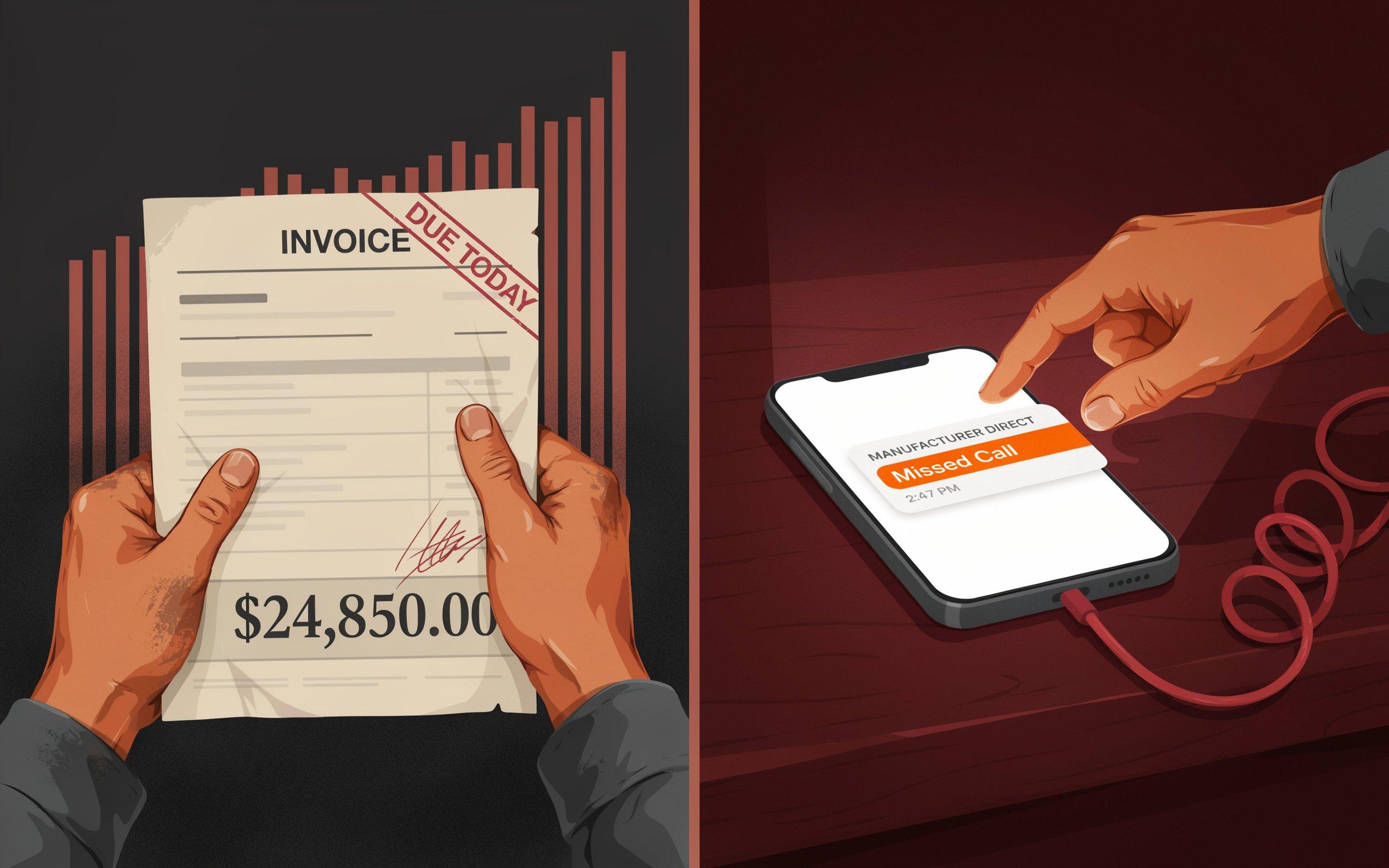
HVAC Margins Are Getting Squeezed. Every Missed Call Makes It Worse.
Manufacturer price increases hit again last month. Chances are yours did too.
Inside the HVAC Business Owners and Contractors group on Facebook, a post about another round of manufacturer hikes got immediate traction. The top comment was blunt: contractors are absorbing the increases because they're afraid to raise their prices. Running on thinner margins than a year ago. Some of them don't even know how thin until the end of the month.
That's the first problem.
The second problem is quieter. It shows up in what doesn't ring, what doesn't get answered, what never makes it onto your dispatch board. Every time a call goes to voicemail during a busy install, every time your office closes at 5 PM and a homeowner's compressor dies at 7, every time a call comes in on a Saturday and hits a full inbox, you lose a job.
The two problems together are the real threat. Margins shrinking from the cost side while revenue bleeds out the phone side. Most HVAC owners are only focused on one of them.
This post is about fixing both.
What's Actually Happening to HVAC Margins Right Now
The margin conversation in the HVAC trade is not new, but it's gotten sharper in 2025 and 2026.
Equipment costs are up. Refrigerant pricing has been volatile since the R-410A phasedown accelerated the transition to A2L refrigerants. Labor is tighter in most markets. Insurance premiums for HVAC operations have climbed. Fuel and fleet costs haven't come down meaningfully.
One contractor in the Facebook group put a hard line in the sand: no project below 20% net profit margin. His argument was that healthy margins allow you to absorb the unexpected, invest in your team, and not be one bad month away from a cash problem.
That's the right philosophy. But here's the tension: when margins are already compressed by cost increases you can't fully control, the revenue side of the equation has to be airtight. You cannot afford to give away jobs. You cannot afford to lose leads to voicemail. You cannot afford to let a competitor answer the call you missed.
And yet that's exactly what most HVAC operations are doing, every single day, without realizing it.
The Revenue Leak You're Not Tracking
Most HVAC owners track their job count, their revenue per job, and their monthly close rate. What almost nobody tracks is their missed call conversion rate.
Here's why that number matters more than most owners think.
The average HVAC replacement job in a residential market runs between $4,200 and $8,500 depending on system size, equipment tier, and whether there's ductwork involved. A service call that leads to a repair is typically $350 to $900. Emergency after-hours calls carry a premium on top of that.
Now think about a typical week during peak cooling season. Your phone rings 80 to 100 times. Your office is staffed from 7 AM to 5 or 6 PM. That leaves 13 to 15 hours every day, plus weekends, where incoming calls either hit voicemail or get routed to someone who can take a message but can't book a job.
Conservative estimate: 20% of your weekly call volume hits outside business hours. If you're getting 90 calls a week, that's 18 calls going to voicemail. Industry data on home service businesses shows that roughly 62% of callers who hit voicemail do not leave a message. They hang up and call the next name they find.
That leaves you with 11 potential leads per week that disappear without a trace. If 5 of those were bookable jobs at an average of $4,200, that's $21,000 a week in revenue that never touches your Housecall Pro board. Over a 16-week peak season, the number becomes difficult to look at.
The margin problem is real. But for most HVAC companies, the missed call problem is bigger.
Calculate your missed call revenue
Why Raising Your Prices Is Not Enough
The advice you'll hear in contractor circles right now is to raise your prices and protect your margins. That advice is correct. But it only works if you're capturing every job you could be capturing.
Think about it this way. You raise your average job ticket by $400 to offset rising equipment costs. Good move. But if you're still missing 5 jobs a week to voicemail, you've protected the margin on the work you're doing while ignoring the revenue you're not doing.
A 20% net margin on $4,200 is $840. You raised your price to protect that number. But the $4,200 job you lost on Saturday night at 8 PM because nobody answered the phone? That's $840 you never had a chance to earn.
Price increases protect the jobs inside your system. An AI answering service protects the jobs that would have never made it into your system.
You need both.
What an AI Phone Agent Does That a Voicemail Can't
The gap between a voicemail and an answered call is not just about customer experience. It's about timing, and timing in residential HVAC is everything.
When a homeowner's AC goes down on a 94-degree afternoon, their decision window is short. They search, they call, they pick the first company that answers with a real response. Not a recording. Not a promise to call back. An actual answer.
An AI answering service for HVAC contractors answers every call in under 2 seconds, around the clock, with no sick days, no call rotation burnout, and no messages that pile up until Monday.
Here's what the AI captures on every call:
- Customer name, address, and contact information
- Description of the problem, including urgency signals like "no cooling" or "water leaking"
- Preferred appointment window
- Whether it's a new customer or an existing one
That information goes directly into your field service management software. If you run Housecall Pro, the job is on your dispatch board before the call ends. If you use ServiceTitan or Jobber, same result. No manual entry. No missed detail from a sticky note. No lead sitting in someone's voicemail until morning.
For emergency calls, the AI uses triage logic. A call from a customer with an elderly resident and no cooling gets flagged differently than a standard next-day appointment request. You set the rules. The AI follows them.
The homeowner who called at 8 PM on a Saturday gets a confirmed appointment. Your competitor does not get that job. And you wake up Sunday morning with a full Monday board that built itself while you weren't watching.
The Businesses Pulling Away Are Not the Ones Raising Prices Fastest
Here's what's actually separating growing HVAC companies from ones that are grinding harder for the same results.
It's not equipment brand. It's not truck count. It's not even technician quality, though that matters enormously. The biggest operational difference between HVAC companies that are scaling and ones that are plateauing is lead capture rate.
The companies winning right now answer every call. They book every viable lead. They don't have a 5 PM cutoff on their revenue. They run like a 24/7 business even when their team works an 8-hour shift.
An AI phone agent is the infrastructure that makes that possible without hiring a night shift, without burning out your office staff on call rotations, and without paying a national answering service that takes a message but can't actually book the job into your system.
The cost of a done-for-you AI answering service is a fraction of a single missed replacement job. The math on this is not close.
See how other contractors recovered revenue
Protecting Margins Means Protecting Every Dollar of Opportunity
If you're serious about running a profitable HVAC operation in a market where your input costs are climbing and price competition is real, the margin conversation has to include both sides of the ledger.
Cost side: raise prices appropriately, manage your overhead, push back on manufacturers where you can, and run a tight operation.
Revenue side: answer every call, book every job your team can handle, and stop giving away $4,200 jobs to competitors who happened to pick up the phone.
The second half of that equation is what most HVAC business owners are ignoring. Not because they don't care. Because they don't have the infrastructure to do anything about it.
A Done-for-you AI Answering Service changes that without adding headcount, without changing your software stack, and without asking your team to do anything differently. It plugs directly into what you already use and starts capturing the revenue you've been leaving on the table.
Your margins deserve protection on both ends.
Stop Letting Your Competition Steal Your After-Hours Jobs
Manufacturer costs are going up. Labor is tight. Insurance isn't getting cheaper. You cannot control any of that.
What you can control is whether your phone gets answered at 9 PM on a Tuesday when a homeowner's system goes down.
Every missed ring is a competitor getting paid. In a margin-compressed market, that's a hit you cannot keep absorbing.
Get a free Call Flow Audit today.
AUTHOR BIO BLOCK
Author: Bilal Umrani, AI Implementation Specialist at Enumsol
Bio: Bilal helps HVAC and home service contractors close the gap between their field service software and their phone coverage. With hands-on experience implementing AI answering systems for residential and commercial HVAC businesses, Bilal focuses on one outcome: capturing every lead before a competitor does.