
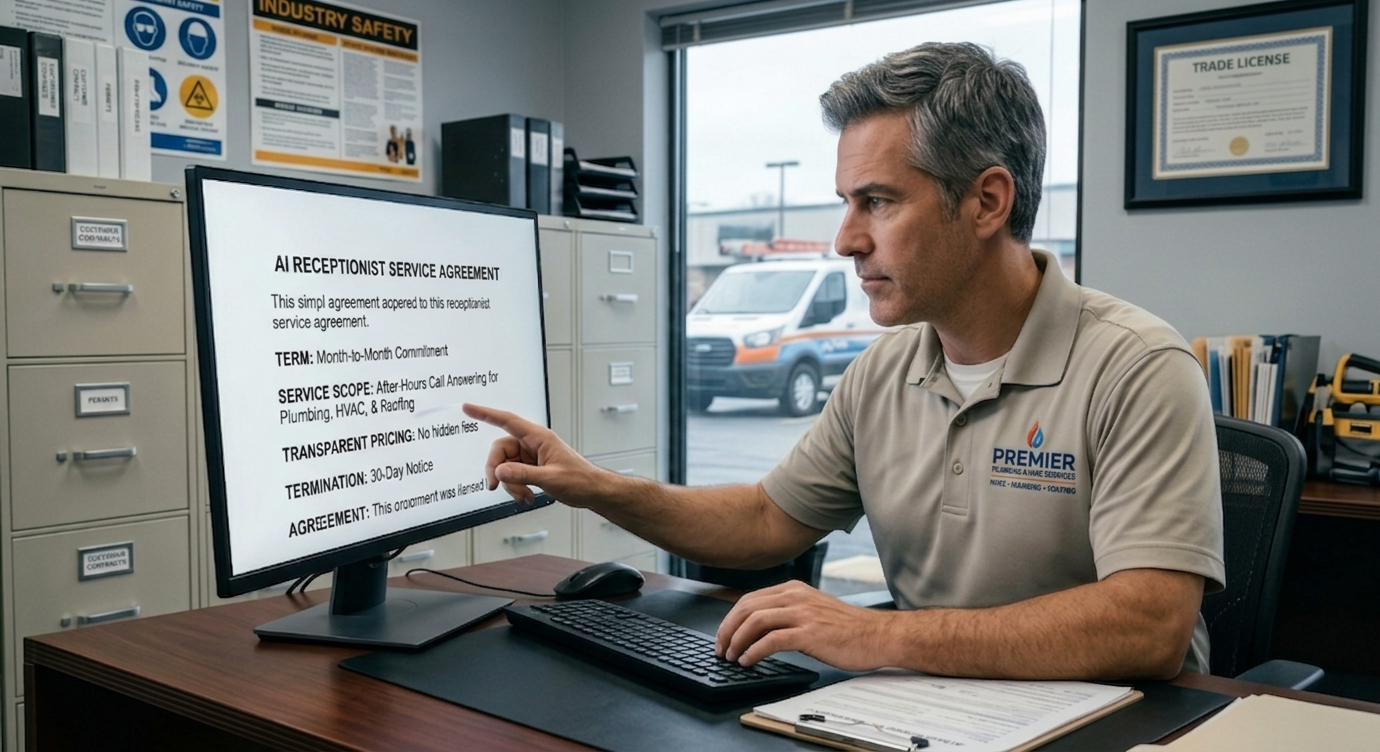
The Software That Sat Unused for Fourteen Months
Two years ago, a roofing contractor outside of Dallas signed up for a call management platform. Twelve-month contract, paid upfront, solid demo, promising features. His office manager spent three weeks trying to configure it. His dispatchers found workarounds rather than learning a new system.
By month four, the platform was essentially unused — running in the background, collecting a monthly fee, and doing nothing to recover the after-hours calls the owner had signed up to capture in the first place.
When the contract came up for renewal, he didn't renew. He also didn't try anything new for the next eighteen months. Not because the problem went away — his phones were still going unanswered after 6 p.m., and leads were still slipping to competitors — but because he'd been burned once, and the idea of signing another agreement for a solution that hadn't proven itself felt like a risk he wasn't willing to take again.
That story is not unusual. It is, in fact, one of the most common reasons home service business owners hesitate when evaluating any new operational solution — and it's a completely rational response to a real pattern of broken promises dressed up in contract language.
Why the Contract Question Is Really a Trust Question
When a contractor asks "is there a contract required," they're rarely focused on the legal document itself. What they're actually asking is: how much risk am I taking on before this proves it works?
That's a smarter question than most vendors give credit for. A long-term contract signed before a solution has demonstrated measurable results in your specific operation is a risk transfer — from the vendor to you. You're absorbing the downside if it doesn't work, while the vendor collects revenue either way. For a business owner who thinks in terms of truck rolls and job margins, that math is obviously unfavorable.
The right answer to the contract question, then, isn't just about duration or cancellation terms. It's about the structure of the commitment relative to the structure of the proof. A solution that requires you to commit before it proves value is a different proposition than one that proves value before asking for commitment. The difference between those two models is the difference between a vendor that believes in its outcomes and one that doesn't.
What a Low-Risk Commitment Structure Actually Looks Like
The standard SaaS model in the home services technology space is straightforward: sign a contract, pay per seat or per month, configure the system yourself, and hope the results follow. The contract comes first. The proof, if it ever comes, comes later.
A genuinely results-oriented deployment model works in the opposite direction.
It starts with an audit — a review of your actual call data to identify exactly where revenue is leaking and what closing that gap is worth in measurable dollars. No commitment required at this stage. The audit exists to give both parties a clear, data-grounded picture of the opportunity before any agreement is signed.
From there, a focused two-week pilot tests the solution on a single channel against a real baseline. Call pickup rate, qualified leads generated, and jobs booked are measured against your existing numbers. The pilot is narrow by design — one use case, one time window, one clear metric. It is not a broad rollout.
It is a controlled test with a defined outcome. Only when that test produces verifiable results does expansion make sense — and that expansion is justified by the data, not by a contract clause.
This structure changes the nature of the commitment entirely. You are not being asked to bet on a promise. You are being asked to evaluate a result.
The Real Cost of Waiting for Perfect Terms
There is a version of the contract conversation that becomes its own trap.
A contractor who spends weeks negotiating exit clauses and month-to-month flexibility — without moving forward — is still losing calls in the meantime. According to Invoca Research, 60% of high-intent calls to home service businesses occur outside of standard business hours. For a mid-volume operation, that represents a substantial portion of weekly lead volume arriving at exactly the hours the phone goes unanswered. Every week spent evaluating terms rather than testing a solution is another week of that revenue going to a competitor who picked up.
The CallRail Benchmarking Report confirms that improvements in call pickup rate produce measurable booking rate changes almost immediately after coverage gaps are closed. The opportunity does not wait. Customers who call at 9 p.m. with an HVAC failure are not going to call back tomorrow morning when your office opens — they're going to call the next number on the list until someone answers.
Protecting yourself from a bad contract is a legitimate concern. Letting that concern delay a decision indefinitely while revenue continues to leak is a different kind of risk — one that shows up in your monthly numbers rather than a legal document.
What to Actually Look for in Any Agreement
For contractors evaluating any AI voice solution, the terms worth paying attention to are simpler than most vendors make them seem.
Does the deployment begin with an audit of your actual data, or does it begin with a signature? Is there a defined pilot phase with measurable success criteria before a longer commitment is expected? Is performance tracked against a real baseline, or against activity metrics that look good on a dashboard but don't translate to booked jobs? And critically — is the vendor's revenue tied to your results, or to your monthly payment regardless of outcome?
These questions separate a solution structured around your success from one structured around the vendor's recurring revenue. The answers tell you more about the actual risk of the commitment than any contract length or cancellation policy will.
Enumsol's AI Voice Receptionists are deployed through exactly this structure — audit first, controlled pilot second, expansion only where results justify it. The commitment follows the proof. That sequence is not an accident; it is the model that makes long-term partnerships in this industry actually work.
Conclusion
The contract question is not a paperwork question. It is a question about who carries the risk when a solution is deployed in your operation — and whether the structure of the engagement is designed to protect you or to protect the vendor. For home service contractors who have been burned by software they paid for and never used, the instinct to scrutinize the terms before signing anything is exactly right.
The commitment worth making is one backed by data collected from your own call logs, tested against your own baseline, and expanded only when your own numbers confirm it's working — so the real question isn't whether to sign a contract, but whether the solution you're evaluating has enough confidence in its own results to let you see them before you do?
Sources: Invoca Research on after-hours inbound call volume and high-intent call behavior in home service businesses; and the CallRail Benchmarking Report on the relationship between call pickup rate improvements and measurable booking rate changes in local service operations.