
Dave runs a four-truck electrical company in the Carolinas. He'd been hearing about AI answering systems for about eight months before he finally asked someone about it directly. His question wasn't about cost. It wasn't about features.
It was: "Do I have to redo my whole phone setup?" He'd spent three years building out his current system — a main business line, a separate dispatch number, call forwarding rules he'd configured himself on a Sunday afternoon. The idea of ripping that out and starting over was a nonstarter. So he hadn't done anything. The calls kept coming.
The after-hours calls kept going to voicemail. The jobs kept walking.
When he found out the answer to his question was simply no — that nothing about his existing phone infrastructure needed to change — he'd been sitting on a solvable problem for the better part of a year.
That story is more common than most contractors would admit. The technical question is the one that stalls the conversation. And in almost every case, the concern is bigger than the reality.
The Short Answer
You do not need a new phone number, a new phone system, or any specialized hardware to run an AI receptionist on your inbound calls.
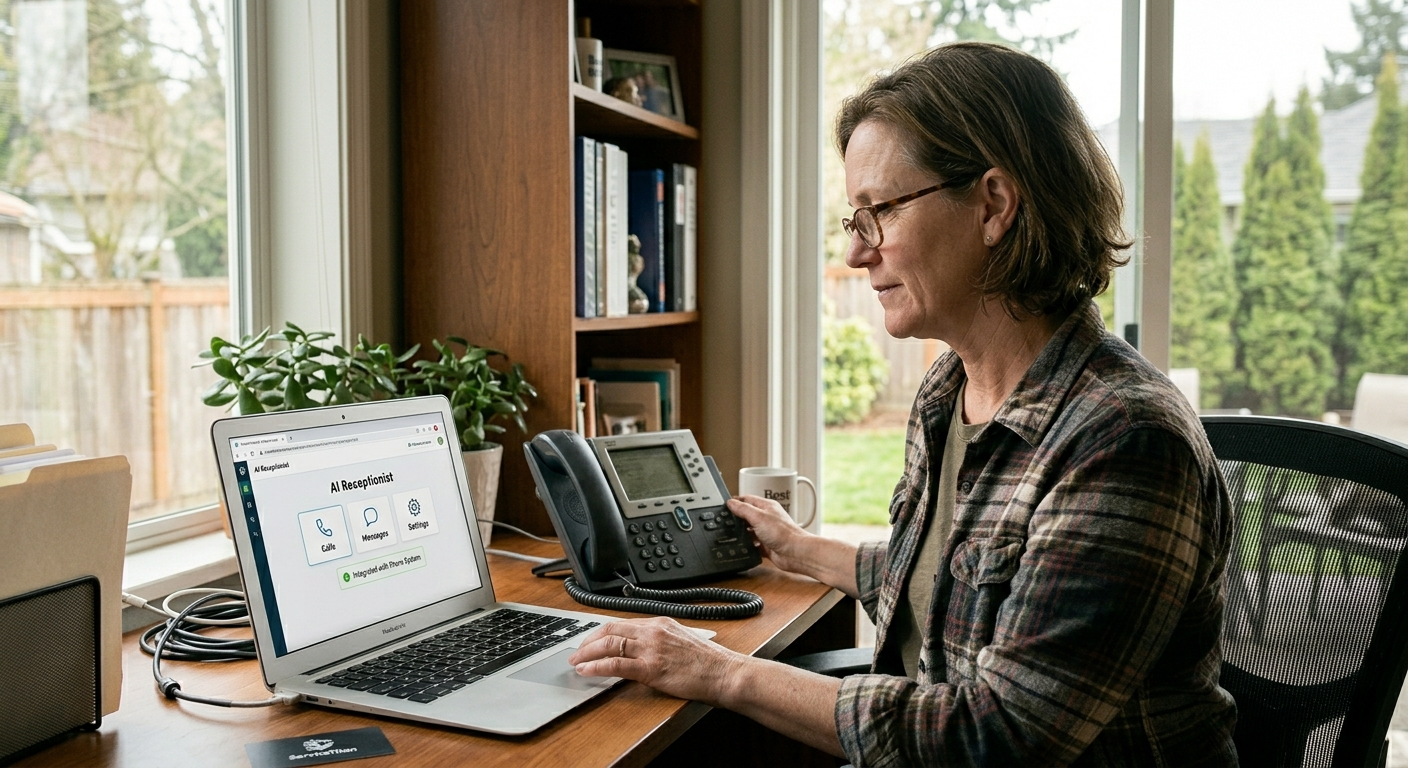
What the setup actually involves — in plain terms — is call routing. Your existing business number stays exactly where it is. Calls that come in outside business hours, or overflow calls that your dispatchers can't pick up fast enough, get forwarded to the AI system through your current phone provider's call forwarding settings. When the AI completes the intake, the structured lead record goes into your dispatch software.
Your team picks it up from there.
For contractors already running on platforms like ServiceTitan or Housecall Pro, this integration is straightforward because these systems are built to receive inbound job data from external sources. The connection point already exists. The AI intake system connects to it.
No new hardware. No porting your number. No weekend spent reconfiguring your phone tree.
What "Technical Requirements" Actually Means for a Trades Business
The phrase "technical requirements" tends to make contractors think in terms of equipment — new phones, new servers, new subscriptions layered on top of existing ones. In practice, the requirements for adding an AI receptionist to a home service operation are almost entirely operational, not technical.
Here is what actually matters before setup:
Your existing call forwarding capability. Every major business phone provider — VoIP systems, traditional landlines, and mobile carriers alike — supports call forwarding. Whether calls route to the AI during after-hours windows, during overflow conditions when all dispatchers are busy, or full-time as a first point of contact, the mechanism is the same one you're probably already using when you forward calls to your personal cell on weekends.
Your dispatch software access. The output of every AI-handled call is a structured job record that needs somewhere to go. If you're on ServiceTitan or Housecall Pro, the integration path is established. If you're on a different platform, the conversation starts with confirming that integration is supported — which a properly managed service handles before anything goes live.
A clear definition of which calls you want handled. This is the piece that requires the most thought — not the technology, but the workflow decision. Do you want the AI to handle all calls outside business hours? Overflow calls only?
Emergency dispatching specifically? Defining the use case is the actual setup work. The phone configuration follows from that decision, not the other way around.
That's the complete list. For a business owner who has spent time thinking about dispatch software integrations, technician routing rules, and seasonal staffing adjustments, none of this represents unfamiliar territory. It's the same kind of operational configuration decision you've already made a dozen times.
The Question Behind the Question
When contractors ask whether they need a special phone line, they're usually asking something more fundamental: is this going to be a project?
That's the real concern — not the phone line itself, but the time cost, the disruption, the potential for something to break during a busy week, the possibility of ending up responsible for troubleshooting a system they didn't fully understand when they agreed to it.
Those are legitimate concerns. And they're exactly why the deployment model matters as much as the technology.
A fully managed implementation — where the setup, integration, and testing are handled by the service provider rather than handed off to the contractor — means the technical configuration work is never the business owner's problem. What the owner needs to provide is operational input: their service area zip codes, their after-hours handling preferences, their emergency dispatch criteria, their existing software login credentials. The rest gets built around that.
CustomerFlows Home Service Business Statistics 2026 found that the most commonly cited barrier to AI call handling adoption among home service businesses wasn't cost or skepticism about effectiveness — it was perceived implementation complexity. Business owners assumed the setup would require IT resources or significant time investment they didn't have. In practices where setup was managed end-to-end by the provider, that barrier effectively disappeared.
What Actually Requires Attention Before You Go Live
The technical side of setup is not where problems occur. The operational side is — and knowing where to focus that attention upfront saves significant time later.
Call routing logic. The most important pre-launch decision is defining when and how calls route to the AI. After-hours only is the cleanest starting point — it's the window with the highest volume of unhandled calls and the lowest risk of disrupting existing dispatcher workflows. Overflow routing requires slightly more configuration because it depends on conditions inside your current call handling flow, not just time-of-day rules.
Starting with after-hours, running a controlled proof of concept, and expanding based on results is both the lower-risk and the more measurable approach.
Service area and triage parameters. The AI intake process needs to know your zip code coverage, your emergency criteria, your standard call types, and how urgency levels map to dispatch priority. This isn't technical setup — it's the same information your best dispatcher carries in her head after two years on the job. Getting it out of her head and into a structured format is the actual work.
Dispatch software configuration. If your ServiceTitan or Housecall Pro instance has job type categories, custom fields, or specific booking workflows, those need to be reflected in how the AI generates its output records. A few hours of configuration work upfront prevents mismatches between what the AI captures and what your dispatch board expects to receive.
These are the conversations that matter before launch. None of them require a new phone line.
After-Hours Is Where the Setup Pays Off Fastest
The reason after-hours call handling is the recommended starting point for most home service operations isn't just because it's the easiest configuration — it's because it's where the ROI is most immediate and most measurable.
Industry research consistently indicates that a substantial portion of high-intent inbound calls to home service businesses — emergencies especially — arrive during evening and weekend hours when no dispatcher is available. These calls currently go to voicemail, generate no lead record, and result in no follow-up because the caller hung up before the beep.
The only thing standing between those calls and a booked job is a phone routing rule that sends them somewhere other than voicemail. That rule exists in your current phone system settings right now. It just needs a destination.
Enumsol's AI Voice Receptionists are deployed specifically in this gap — handling after-hours and overflow call volume, capturing complete caller data, and pushing structured job records directly into your dispatch platform. The 58 percent increase in after-hours booked jobs that one HVAC client documented over 90 days wasn't the result of a complex technical overhaul. It was the result of correctly routing calls that were already coming in.
The Cost of Waiting for the "Right" Setup Moment
There's a version of this conversation that plays out in a lot of contractor offices: the business owner agrees the problem is real, acknowledges the solution is straightforward, and then decides to revisit it after the busy season. Or after they hire one more dispatcher. Or after they finish the ServiceTitan migration. Or after things slow down a little.
The problem with that logic is that the after-hours calls don't wait for a convenient implementation window. They come in tonight. They came in last night. They came in every night for the past year while the decision sat in a "revisit later" folder.
Invoca's research on inbound call behavior in service industries found that phone calls convert to booked customers at a meaningfully higher rate than any other inbound channel — which makes every unanswered call a disproportionate revenue loss relative to, say, an unread web form submission. The lead quality that comes through an inbound call is the highest in your entire marketing funnel. The technical barrier to capturing it is among the lowest.
Enumsol's process begins with a 30-day call audit that establishes exactly what is currently being missed — not an estimate, but an actual dollar figure derived from your real call data. That audit happens before any configuration changes, before any routing adjustments, before anything technical is touched. It answers the question that matters most: how much is the current setup costing you, and what would change if those calls were handled correctly?
Conclusion
The phone line was never the problem. It was never going to be the problem. Your existing number works. Your existing phone provider supports call forwarding.
Your existing dispatch software has an integration path. The operational decisions that precede setup — which calls to route, how to define an emergency, what your service area boundaries are — are decisions you've already made in practice, even if you've never written them down.
What sits between a contractor and a fully functioning AI call intake system isn't a technical requirement they haven't met. It's the thirty minutes it takes to confirm that every piece they need is already in place — and the decision to stop losing the jobs that are calling in every night while that conversation keeps getting postponed.
So the real question isn't whether your phone setup is ready — it's how many after-hours jobs have already walked out the door while you were waiting to find out?
Sources: CustomerFlows Home Service Business Statistics 2026 on perceived implementation complexity as a barrier to AI call handling adoption in home service businesses; Invoca Research on inbound phone call conversion rates relative to other inbound channels in service industries; industry research on VoIP and call forwarding adoption rates among small-to-mid-size field service businesses.