
Marco had been running his plumbing company for eleven years. Four trucks. Two dispatchers. A solid reputation in his market.
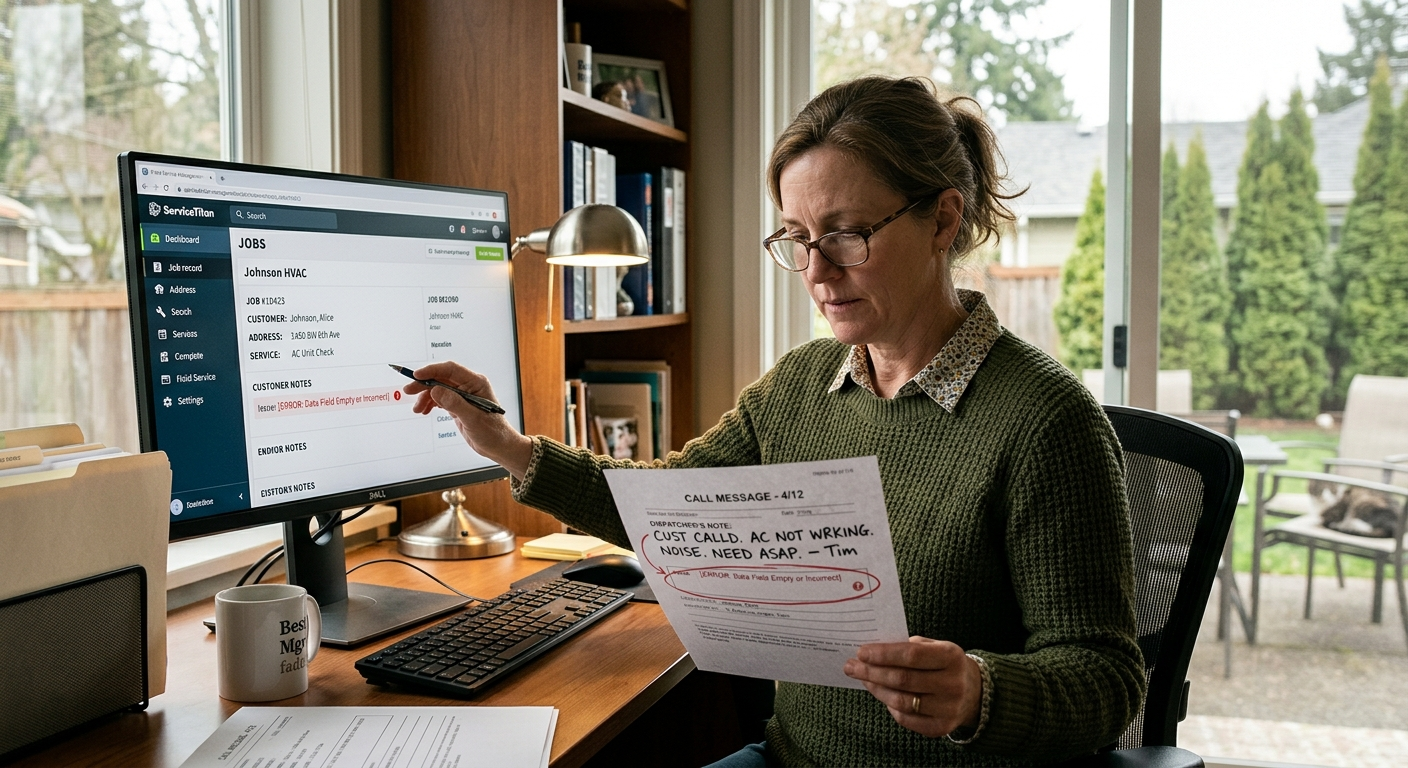
On a Wednesday morning in early March, a homeowner called about a water heater failure — older unit, full replacement likely. His dispatcher took the message between two other calls: scribbled a first name, a number with one digit transposed, and "water heater something." By the time Marco's team tried to call back two hours later, the number didn't connect. They tried spelling variations of the name against their CRM. Nothing.
The job — a high-probability $1,800 to $3,200 ticket — was gone. Not because Marco's team didn't care. Because the message was wrong.
That story repeats itself dozens of times a week in shops just like his. And it almost never shows up on a profit-and-loss report. It just disappears.
The Message Problem Nobody Tracks
There's a reason most home service business owners don't know exactly how many jobs they lose to bad messages — because a bad message looks, on the surface, like an attempted callback that went nowhere. It gets logged as a missed follow-up, not a data integrity failure. The root cause stays invisible.
But the data tells a different story. The 411 Locals Industry Study identified inaccurate lead records and dispatcher transcription errors as among the most frequently cited operational causes of failed follow-up in home service businesses. The problem isn't intent. It's the conditions under which messages get taken.
A dispatcher fielding calls during a busy morning rush is simultaneously managing a live conversation, recalling service area details, checking the dispatch board, and logging information in real time. Under those conditions — especially during peak season or a marketing campaign surge — message accuracy degrades in predictable ways. Phone numbers get transposed. Last names get dropped.
Service types get summarized so loosely that the callback starts from scratch with zero context. Access notes, urgency flags, and scheduling preferences don't make it into the record at all.
CallRail's benchmarking research on inbound call handling found that a notable share of inbound calls to home service businesses result in incomplete records — with callback numbers and service descriptions being the most commonly missing or inaccurate fields. For a contractor spending money on Google ads or local SEO, that's not just an operational inconvenience. It's a direct leak in the return on every marketing dollar spent.
What "Accurate" Actually Means in a Trades Context
Accuracy in message-taking isn't the same thing for a roofing contractor as it is for a doctor's office. In the trades, message accuracy is measured by whether the information in the record is sufficient to take the next action — dispatch a truck, book an appointment, or route an emergency — without a follow-up call to re-gather the basics.
A complete, accurate message for a home service business includes:
The correct callback number, confirmed during the call. A wrong digit here ends the conversation before it starts. Industry research consistently shows that an incorrect or incomplete phone number is the single most common reason a warm lead never converts — not because the business didn't try, but because they literally could not reach the person back.
The correct service address, including zip code verification. An address without a confirmed zip code creates dispatch risk. A dispatcher who sends a technician to the wrong side of town — or worse, outside the service area entirely — has burned truck time and technician wages on a call that should have been caught at intake.
A clearly classified service type. "Needs help with something electrical" is not a message. It's a placeholder. Accurate classification — panel upgrade, outlet repair, emergency outage, EV charger installation — determines how the job gets prioritized, which technician is assigned, and what the truck needs to carry before leaving the yard.
An urgency designation. Failing to capture whether a call is an emergency versus a routine request doesn't just affect scheduling — it affects customer experience, liability exposure, and ultimately job reviews. A homeowner who called about a burst pipe at 9 PM and got a Tuesday morning callback will not leave a five-star review.
Caller-provided context and notes. Gate codes. Apartment numbers. Active warranties.
Pets on-site. These details are mentioned once, at the time of the call, and they never come up again. If they don't make it into the job record on the first pass, they simply don't exist — and the technician shows up without them.
How Human Message-Taking Breaks Down Under Pressure
This isn't a criticism of dispatchers. It's an observation about systems under load.
When call volume is low and staffing is adequate, human dispatchers are capable of taking excellent messages. They can ask follow-up questions, clarify spelling, confirm addresses, and enter data cleanly. The problem is that home service businesses don't fail during quiet Tuesdays in April. They fail during August heat waves, January cold snaps, and the three weeks after a major marketing campaign launches — exactly when call volume spikes and dispatcher capacity is stretched thinnest.
Research from Newo.ai industry analysis on call handling performance in field service businesses found that message accuracy rates dropped measurably during peak call periods compared to average-volume days. The degradation wasn't random — it clustered around specific failure types: transposed digits in phone numbers, missing service classifications, and absent urgency flags. In other words, the exact fields that determine whether a lead can be acted on quickly.
Harvard Business Review research on operational performance under cognitive load has consistently shown that multitasking in high-stakes environments introduces error rates that feel invisible in the moment but compound into significant operational costs over time. For a dispatcher managing four calls in forty minutes, the cognitive overhead of accurate data entry while maintaining a professional caller experience is genuinely difficult — not because they're unskilled, but because the system is asking them to do two demanding jobs simultaneously.
Sameday AI performance research across home service operations found that businesses using structured automated call intake — rather than dispatcher-logged messages — reported a substantial reduction in follow-up failures attributable to data entry errors, with callback-number accuracy showing the largest measurable improvement.
Where Message Inaccuracy Hits the Hardest: After Hours
The message accuracy problem doesn't just exist during business hours. It's actually worst in the window when your business is most exposed: evenings, early mornings, and weekends — when voicemail is the only alternative to a live dispatcher.
Industry research consistently shows that approximately 60 percent of high-intent inbound service calls to home service businesses occur outside standard business hours. These are the calls from homeowners facing actual emergencies — no heat, active leaks, power failures — who are calling with money in hand and urgency driving every decision.
When those calls go to voicemail, two things happen. First, most callers don't leave a message. Research from Invoca on inbound call behavior in high-intent service categories found that the voicemail abandonment rate for first-time callers is significantly higher than commonly assumed — the majority hang up without leaving any record of the call. Second, the callers who do leave a message often leave one that's incomplete: a first name, a vague description, and a number that may or may not be legible on playback.
The dispatcher who arrives at 8 AM to twelve voicemails is not working with twelve leads. She's working with twelve fragmented audio clips of varying quality, each of which requires a separate callback to rebuild the information that should have been captured the night before — at the moment the caller was most motivated to hire.
Aire Serv after-hours booking analysis found that home service businesses with automated after-hours call intake — capturing structured, complete caller data in real time — significantly outperformed those relying on voicemail and morning callbacks, not just in total jobs booked but in lead conversion rate per inbound contact. The gap wasn't about marketing. It was about message quality at the point of first contact.
How Automated Intake Changes the Accuracy Equation
The accuracy advantage of a well-deployed automated intake system isn't primarily a technology story. It's a consistency story.
A human dispatcher under pressure takes a message differently at 2 PM than she does at 9 AM. She asks different follow-up questions depending on how many calls are holding. She logs urgency differently on a quiet Monday than she does the day after a major storm. Those variations are human and understandable — but they produce inconsistent records, and inconsistent records produce inconsistent follow-up.
An automated intake system conducts the same structured conversation on every call, regardless of time of day, call volume, or what else is happening in the office. The phone number gets confirmed. The address gets verified against service area coverage. The service type gets classified.
The urgency level gets flagged. Every time, without variation.
Enumsol's AI Voice Receptionists are built specifically around this consistency requirement for home service operations. Rather than capturing a loose message and handing it off, the system generates a complete, structured lead record — address confirmed, service type classified, urgency designated — and pushes it directly into ServiceTitan or Housecall Pro before a dispatcher ever touches it. What arrives on the dispatch board isn't a message to be decoded. It's a job ready to be routed.
The 58 percent increase in after-hours booked jobs and the 4.3 times more qualified emergency calls captured per week that Enumsol clients have documented aren't outcomes of better technology. They're outcomes of better data — captured completely, at the moment of the call, every time.
The Follow-Up Math Nobody Does
Here's a simple calculation that most home service operators have never run.
Take the number of inbound calls your business received last month. Subtract the ones that resulted in a complete, accurate lead record — correct number, confirmed address, classified service type, urgency flag. The difference between those two numbers, multiplied by your average job value, is a conservative estimate of the revenue that passed through your phone line and out the back door because the message was incomplete or inaccurate.
For a mid-volume HVAC contractor averaging sixty inbound calls per month with a $900 average job value, a 20 percent message accuracy failure rate represents over $10,000 in monthly revenue that got generated by marketing, entered the funnel, and evaporated before a dispatcher could act on it.
CustomerFlows Home Service Business Statistics 2026 found that contractors who implemented structured call intake processes — replacing manually logged messages with automated data capture — reported average lead-to-booked-job conversion improvements of 20 to 35 percent, without any change to their marketing spend or technician headcount. The revenue was already coming in. The intake process was just losing it.
The MIT Lead Response Management Study, conducted by Dr. James Oldroyd, adds another dimension to this math: the probability of successfully contacting a lead falls by over ten times after just one hour. An inaccurate message that requires a morning callback is, statistically, nearly ten times less likely to result in a booked job than a complete record that enables immediate follow-up at the time of the call.
What This Means for Your Dispatchers
There's a team cost to poor message accuracy that doesn't show up in job conversion data — but every operations manager recognizes it immediately.
When dispatchers spend their mornings piecing together incomplete voicemails, calling back numbers that don't connect, and rebuilding lead context from fragments, they're not dispatching. They're doing recovery work. And recovery work is the lowest-value activity a skilled dispatcher can perform.
The contractors who win in competitive markets aren't the ones with the most dispatchers. They're the ones whose dispatchers spend their time routing high-value jobs and managing active technicians — because the intake work is handled before they ever sit down in the morning.
Enumsol's audit-first approach starts by identifying exactly where message accuracy is breaking down in your current operation — not where you assume it is, but where the call logs and missed follow-up patterns actually show it. That 30-day audit determines what's being lost, what it's worth, and what a structured intake system would recover. No guesswork. No broad rollout.
Just a clear baseline and a controlled proof of concept.
Conclusion
The accuracy of a message taken under pressure isn't a reflection of your team's competence. It's a reflection of what any human being can reasonably do when they're fielding three calls at once, managing a dispatch board, and trying to maintain a professional conversation with a homeowner whose basement is flooding.
The dispatchers you're paying for high-value work are currently spending meaningful portions of their day doing low-value data recovery — chasing down incomplete records, re-calling unanswered numbers, and reconstructing jobs from fragments. That's not a people problem. That's a systems problem with a measurable dollar value attached to it.
The calls are already coming in. The homeowners are already motivated. The marketing is already working. The only question worth asking at this point is: how much revenue are inaccurate messages costing your business every single month — and what would it take to find out?
Sources: CallRail Benchmarking Report on inbound call handling and incomplete lead records in home service businesses; Newo.ai Industry Research on call handling accuracy rates during peak versus average volume periods in field service operations; Harvard Business Review research on operational error rates under cognitive load and multitasking conditions; Sameday AI Performance Data on data entry accuracy comparisons between automated intake and dispatcher-logged messages; CustomerFlows Home Service Business Statistics 2026 on lead-to-booked-job conversion improvements following structured intake implementation.