
The Call She Did Not Know Was Different
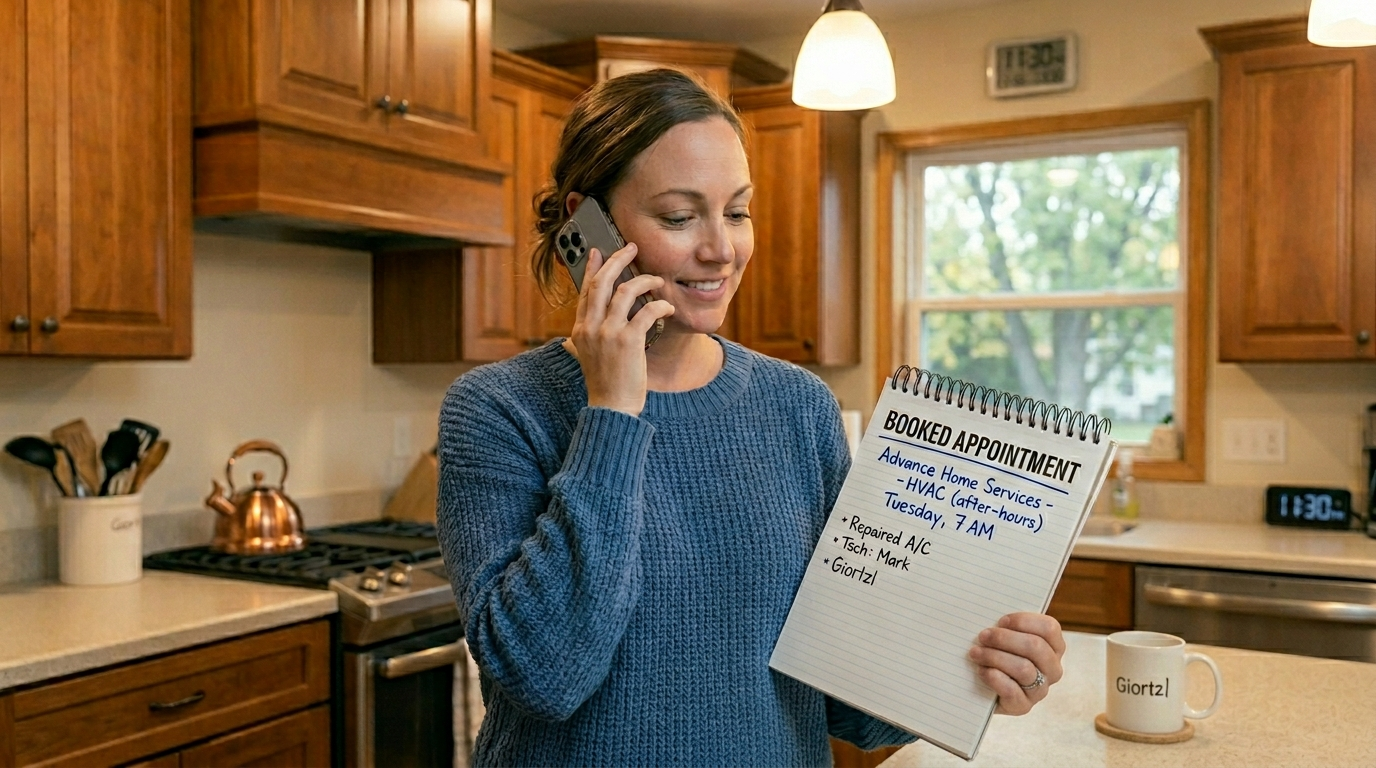
Linda's water heater failed on a Sunday evening in February. Cold water, two kids, and a husband out of town. She grabbed her phone and started calling plumbers. The first two went to voicemail.
The third one picked up in under two seconds. The voice on the other end was calm, clear, and asked exactly the right questions — what was the issue, what was the address, what type of unit did she have. Within four minutes, Linda had confirmed her service area, received a callback window for the following morning, and been told a technician would reach out to confirm the arrival time by 8 AM.
She booked the job on the spot. She left a five-star review three days later describing the company as "professional, responsive, and the only one who picked up." What Linda did not know — and what did not affect her review in any way — was that the voice that answered was not a person. It was a structured call handling system. What mattered to Linda was not who answered.
It was that someone did.
This is the reality that most home service owners are missing when they worry about how their customers will react to automated call handling. The question customers are asking is not "was that a human?" The question they are asking is "did I get helped?"
The Wrong Fear Is Running the Conversation
There is a concern that shows up in almost every conversation home service business owners have about changing their call handling: what will my customers think? It is framed as a loyalty question, a brand question, a trust question. The assumption underneath it is that customers have a strong preference for human interaction at every touchpoint — and that anything less will damage the relationship.
That assumption is worth examining against what customers actually report about their service experiences.
According to PwC's Future of Customer Experience research, 82% of consumers in the United States say they want more human interaction in service contexts — but the same research shows that what they define as a good experience is almost entirely outcome-based. They want their issue resolved quickly, their time respected, and a clear next step confirmed. The interaction style is secondary to whether those outcomes were delivered.
In home services specifically, the context matters enormously. A homeowner calling about a burst pipe is not evaluating the conversational warmth of whoever answers. They are evaluating whether their problem is being taken seriously, whether someone is coming, and when. The experience that earns a five-star review in that context is a fast answer, a competent intake, and a confirmed appointment — not the personality of the voice on the line.
What Customers Actually Complain About in Home Services
To understand what customers think about call handling, start with what they complain about. Online reviews for HVAC, plumbing, electrical, and roofing businesses are a consistent data source on customer experience — and the patterns are clear.
According to consumer review analysis across local service categories, the most frequent complaints in home service reviews fall into three categories: nobody answered or called back, the wait time was too long, and the problem was not properly understood on the first call. Complaints about automated call handling — about feeling like they were talking to a machine — are a fraction of total negative feedback and are heavily concentrated in contexts where the automated system gave wrong information, failed to escalate properly, or left the caller without a clear next step.
In other words: customers do not object to automated call handling. They object to bad call handling. The distinction matters because the standard they are measuring against is not "was it human?" — it is "did it work?"
Research from the Zendesk Customer Experience Trends Report supports this consistently. Customers across service categories report that their satisfaction is driven primarily by resolution speed and outcome quality. When those two factors are present, the method of initial contact — human or automated — has a negligible effect on satisfaction scores.
The Voicemail Benchmark Is the One That Actually Matters
When home service owners worry about customer sentiment toward automated call handling, they tend to compare it against the idealized version of a live, attentive human dispatcher — someone who answers in two rings, knows the customer's name, and handles the intake flawlessly.
That is not the comparison that is actually relevant to their operation.
The real comparison is voicemail. Because for the 60% of high-intent calls that come in outside business hours, for the overflow calls during a dispatcher surge, for the calls that come in during a campaign push when everyone is already on a line — the alternative to structured call handling is not a warm, attentive human dispatcher. It is a voicemail recording.
And the customer sentiment data on voicemail in service contexts is unambiguous. Research on consumer call behavior across service industries shows that customers reaching voicemail in an urgent service context — home repair, maintenance, emergency response — experience a significant drop in trust and are unlikely to leave a message or call back. The experience of reaching voicemail communicates something specific to the customer: this business is not available when I need them.
A structured call handling system that answers in under two seconds, captures the caller's situation, and confirms a next step communicates the opposite. It communicates that the business is present, organized, and treating the call as the priority it is. That perception — available, responsive, reliable — is exactly what builds the kind of trust that produces five-star reviews and repeat customers.
Urgency Changes Everything About Customer Expectations
There is a meaningful difference between how customers experience automated interaction in low-stakes contexts versus high-stakes ones — and home services almost exclusively operates in high-stakes contexts.
A customer who receives an automated reply to a product inquiry on a retail website has low urgency and high patience. They are comparing options, browsing, and deciding on their own timeline. Their expectation of human interaction is moderate because the stakes are low.
A homeowner with no heat in January, a flooded basement, or a breaker that will not reset is operating from a completely different psychological position. Their urgency is high, their patience is minimal, and their evaluation of the interaction is almost entirely focused on one outcome: is someone going to come fix this, and how fast?
According to consumer research from Accenture on service experience preferences, customers in high-urgency situations prioritize speed and resolution over interaction style at a rate that significantly outweighs preferences in low-urgency contexts. What they remember — and what they report in reviews — is whether the problem got solved, not the mechanics of the intake process.
This is the context in which home service call handling operates. The customer calling about a roofing emergency after a storm does not care whether the intake was handled by a person or a system. They care that their address was captured, that someone is coming out, and that they received a confirmation. Deliver those three things and the review will be positive.
Fail to deliver them — by sending the call to voicemail, by missing the callback, by rushing through the intake — and the review will reflect that failure regardless of who handled the call.
Trust Is Built in the Follow-Through, Not the First Answer
One nuance that rarely gets discussed in the customer sentiment conversation is where trust is actually established in a home service relationship. It is not on the first call. It is in what happens after.
Did the technician show up in the window that was confirmed? Did the callback happen within the hour that was promised? Was the job handled the way it was described during intake? These are the moments that determine whether a customer becomes a repeat caller, a referral source, or a negative review.
A call handling system that captures the lead accurately, confirms the right next step, and pushes the job into the dispatch workflow with complete intake information makes every one of those follow-through moments more likely to go well. The technician arrives with the right information. The callback happens because it was flagged as a priority. The job scope was accurately captured because the intake was structured and thorough.
Customer satisfaction research consistently shows that perceived reliability — the sense that a business does what it says it will do — is the single strongest driver of positive reviews and repeat business in home service categories. Structured call handling that produces accurate, complete intake is a direct input into that reliability. The customer's experience of the brand is shaped less by the first voice they heard and more by whether the company followed through on exactly what that first voice promised.
What Enumsol's AI Voice Receptionists Are Designed to Deliver
This is the standard that Enumsol's AI Voice Receptionists are built around — not passing as human, but delivering the outcomes that customers actually measure. Fast answer. Accurate intake. Clear next step.
Immediate escalation for genuine emergencies. And complete job information pushed into ServiceTitan or Housecall Pro so that the follow-through the customer was promised actually happens.
The deployment starts with a 30-day call audit of the specific operation — understanding what types of calls come in, when they come in, and what the customer expects at each touchpoint. That context shapes how the call handling is configured, what it escalates, and how it communicates next steps. No generic script. No one-size-fits-all workflow.
A system built around the real calls coming into your real operation — and the real customers on the other end of them.
The customer does not need to know how the call was handled. They need to know that it was.
Conclusion
The fear that customers will react badly to automated call handling in home services is understandable — but it is not well-supported by what customers actually report. What they want is to be heard, to receive a clear next step, and to have the business follow through on what was promised. What they do not want is voicemail, a long wait, or an intake that missed half of what they said.
The businesses that earn the best reviews in the trades are not the ones where every single call was handled by a human. They are the ones where every single call was handled well — fast, accurately, with a confirmed outcome and a follow-through that matched what the customer was told.
In a market where 60% of high-intent calls come in after hours and voicemail is the default fallback for most operations, the question is not whether your customers will accept a well-run call handling system — it is whether they will keep accepting voicemail?
Sources: PwC Future of Customer Experience Report; Zendesk Customer Experience Trends Report; Accenture Digital Consumer Pulse Survey; BrightLocal Local Consumer Review Survey; Dimensional Research Customer Service Benchmark Study.