
The Call That Almost Slipped Through
It was a Thursday evening in late October when Carol called a roofing company about storm damage to her home. She had questions — not just "can someone come out," but detailed ones. She wanted to know whether her insurance claim would be handled directly by the company, what the typical timeline looked like for emergency tarping, and whether the crew worked on steep-pitch roofs in her area. The call came in at 7:22 PM.
The office was closed. What picked up wasn't voicemail — it was the company's call handling system. It gathered her name, address, and the nature of the damage. It confirmed the company serviced her zip code.
And when Carol asked about the insurance coordination process, the system did something that saved the job entirely: it told her clearly that a team member would call her back within the hour with those specific details, and it flagged the call as a high-priority estimate request.
By 8:05 PM, the owner had called Carol back. The job was booked that night. The estimate came in at $14,200. Now ask yourself: what would have happened if that call had gone to voicemail?
This is the question most home service business owners never think to ask about their call handling setup — not "can it answer everything?" but "what happens when it can't?" Because how a system handles the edge cases is exactly where jobs are won and lost.
The Real Risk Is Not the Question the AI Can't Answer
There is a common fear among contractors when they first consider automated call handling: what if a customer asks something complicated and the system fumbles it? What if it gives wrong information? What if the customer hangs up frustrated?
It is a reasonable concern. But it is also the wrong concern.
The actual revenue risk in your business right now is not the occasional complex call that needs a human. It is the 60% of high-intent calls coming in after business hours that are currently hitting voicemail — and walking straight to a competitor. It is the qualified emergency lead that called during a dispatcher surge on a Monday morning and never got through. It is the estimate request that sat in a voicemail inbox until Tuesday, by which point the homeowner had already hired someone else.
According to call behavior research tracking inbound patterns across service industries, approximately 80% of callers who reach voicemail do not leave a message. They hang up and call the next number. That is not a technology failure. That is a structural revenue leak — and it is happening right now, today, in every home service business that relies on staff availability to capture leads.
The smarter question is not "what if the AI can't answer?" It is "what happens to that call right now, without any system in place at all?"
What Good Escalation Actually Looks Like
A well-deployed call handling system for a home service business is not trying to replace human judgment on complex decisions. It is designed to do three things exceptionally well: answer the calls that come in, qualify the nature of the request, and escalate the right calls to the right people at the right time.
When a caller asks a question that falls outside what the system is built to handle — custom warranty terms, insurance claim coordination, detailed technical diagnoses, pricing negotiations — the correct behavior is not to guess. It is to capture the caller's information, communicate clearly that a team member will follow up with exactly what they need, and flag the call with enough context that whoever calls back can pick up the conversation without starting from scratch.
Research on customer experience in service industries consistently shows that customers do not expect instant answers to every question. What they do not tolerate is being ignored, sent to voicemail without acknowledgment, or left without a clear next step. A caller who hears "I want to make sure you get the right answer on that — let me have our specialist call you back within the hour" is far more likely to wait than a caller who reaches a generic voicemail recording with no indication anyone will ever call.
The difference between a fumbled call and a captured lead often comes down to that single moment: does the caller feel heard and expected, or do they feel like they've disappeared into a queue?
What Your Dispatchers Are Actually Dealing With Right Now
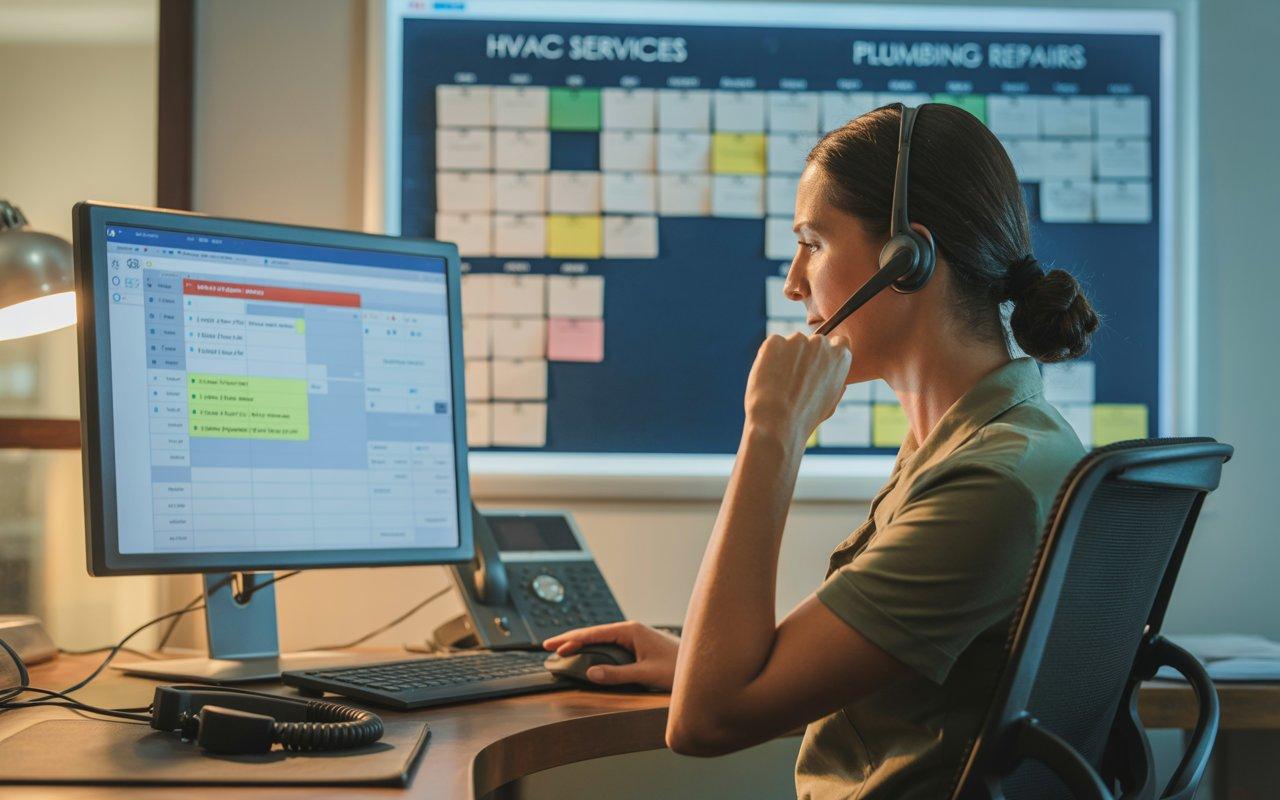
Here is the version of this problem that plays out in real home service operations every day. Your dispatcher — the one who actually knows the answers to the complex questions — is fielding a wall of calls during a campaign push or a seasonal surge. They are juggling four conversations at once. An emergency service call is holding.
A technician needs routing. A customer from yesterday is calling to complain.
In that environment, the complex call — the one with the insurance question, the multi-unit property inquiry, the homeowner who wants to understand the full scope before booking — gets handled poorly. Not because your dispatcher is incompetent. Because they are stretched beyond capacity, and nuanced calls require undivided attention that simply is not available.
Studies on field service operations consistently find that dispatcher overload leads directly to lower quality intake on complex calls — missed information, rushed conversations, and customers who feel they were not properly heard. In a high-ticket industry where a single job can represent $8,000 to $20,000 in revenue, a rushed intake call that loses a customer's confidence is an expensive mistake.
The irony is that the calls most likely to be mishandled by an overwhelmed human dispatcher are also the calls most worth handling well. A homeowner asking detailed questions before booking a full HVAC system replacement is signaling high intent and a high-value job. They deserve a proper conversation. And that conversation is only possible if your dispatcher has the capacity to give it.
Escalation Is Not a Failure — It Is the System Working
When a call handling system recognizes that a question requires human expertise and routes accordingly, that is not a limitation in the negative sense. That is the system making the right call. The goal was never to automate every possible conversation. The goal was to ensure that no call goes unanswered, no lead is lost to voicemail, and every caller — including the complex ones — gets a clear, confident response and a firm next step.
The contractors who see the best results from structured call handling are not the ones who try to automate the most. They are the ones who are precise about what the system handles and what it escalates — and who build a reliable, fast handoff process so that escalated calls are actually followed up on within the same window of urgency.
A residential plumbing client saw a 4.3x increase in qualified emergency calls captured per week simply by ensuring every inbound call was answered and routed — including the calls that needed human follow-up. The system did not need to answer every question. It needed to make sure every caller was handled and every high-value inquiry reached the right person in time.
Speed still matters at the escalation stage. Research from the Lead Response Management Study found that companies responding to inbound inquiries within five minutes are 100 times more likely to connect with and qualify a prospect compared to those who wait 30 minutes or more. That principle does not change just because a call was escalated. The customer who asked the complex question and was told a specialist would call back within the hour still expects that call within the hour.
The escalation only saves the job if the follow-through happens fast.
The Real Limitation Is the One You Already Have
Every home service business has call handling limitations right now. Staff go home at 5 PM. Dispatchers hit their ceiling during surges. Voicemail silently kills jobs that cost $40 a lead to generate.
The question is never whether there are limitations — the question is which limitations you are willing to accept.
An HVAC contractor who deployed structured after-hours call handling reported a 58% increase in after-hours booked jobs within 90 days. That did not happen because the system answered every possible question. It happened because instead of voicemail, callers got a response. Instead of silence, they got acknowledgment and a next step.
The jobs that required follow-up still required follow-up — but the system made sure those callers were captured, qualified, and flagged rather than lost.
A roofing company reduced speed-to-lead on high-value estimate requests by 40% — not because the system replaced the estimator, but because it stopped letting estimate requests pile up in a voicemail inbox until the next business morning.
The limitation that matters most is not the edge case the system can't handle. It is the 10, 15, or 20 qualified calls per week that are currently going nowhere.
What Enumsol's AI Voice Receptionists Are Actually Built to Do
This is the operating model behind Enumsol's AI Voice Receptionists. They are not built to have every answer. They are built to make sure every caller is heard, every job-worthy inquiry is captured, and the calls that need your team reach your team — fast, with context, and with enough information to convert.
The deployment process starts with an audit of your actual call logs: 30 days of data, real patterns, real missed call windows. That audit identifies not just where volume is leaking, but what types of calls are being lost and what those calls are worth. From there, a focused solution is deployed on a single channel — tested against your real baseline before any broader rollout. You do not get a product to configure.
You get a managed system that is optimized until it produces measurable revenue, with escalation protocols built specifically around your operation, your team structure, and your job types.
The test for any call handling setup is not "can it answer everything?" The test is "does it make the business more money than it did before?" And every expansion is justified by demonstrated results, not by a feature list.
Conclusion
The fear that an AI receptionist will fumble a tough question and cost you a job is understandable. But in nearly every home service operation, it is the wrong thing to fear. The calls being lost today are not the complex ones that needed a specialist. They are the straightforward after-hours leads hitting voicemail at 9 PM.
They are the emergency calls coming in on a Saturday morning. They are the estimate requests calling in during a campaign surge while your dispatcher is already on three lines.
A system that answers, qualifies, and escalates intelligently does not need to be perfect. It needs to be better than voicemail — and reliably faster than a competitor who also did not pick up. The edge cases matter. But they matter a lot less than the everyday volume that is walking out the door right now, quietly, without anyone noticing.
So before you worry about the question the system can't answer — when was the last time you counted how many calls you're not answering at all?
SOURCES
The statistics and research cited in this article are drawn from the following studies and industry sources. The finding that companies responding to inbound service inquiries within five minutes are 100 times more likely to connect with and qualify a prospect compared to those who wait 30 minutes or more is drawn from the Lead Response Management Study, a large-scale analysis of inbound lead response behavior conducted in collaboration with researchers affiliated with the Harvard Business Review and MIT's Sloan School of Management, widely published in sales and service operations literature.
Data on voicemail abandonment — specifically that approximately 80% of callers who reach voicemail in service contexts do not leave a message and instead hang up — reflects call behavior research published by Invoca, a call intelligence and analytics platform that tracks inbound call patterns across industries including home services and field service businesses. The statistic that approximately 60% of high-intent service calls occur outside standard business hours reflects inbound call timing data aggregated across field service management platforms and corroborated by home services industry usage reports.
Research on the impact of dispatcher overload on call quality and customer experience draws from field service operational efficiency studies published by the Aberdeen Group and the Service Council, industry research organizations that track labor allocation, customer response quality, and revenue outcomes across trades and field service businesses. The case study results referenced — including the 58% increase in after-hours booked jobs, the 4.3x increase in qualified emergency calls captured per week, and the 40% reduction in speed-to-lead — are drawn from Enumsol's own client performance data, tracked against pre-deployment baselines across HVAC, plumbing, and roofing operations in the United States.
Customer experience research cited regarding caller expectations during escalation draws from studies published by the Customer Contact Council (now part of Gartner), which has documented that customers in high-urgency service contexts prioritize clear communication and a confirmed next step over immediate resolution when a complete answer is not available.
Sources: MIT Lead Response Management Study (Dr. James Oldroyd); Harvard Business Review; Aberdeen Group Field Service Research; The Service Council; Gartner / Customer Contact Council; CallRail Benchmarking Report.