
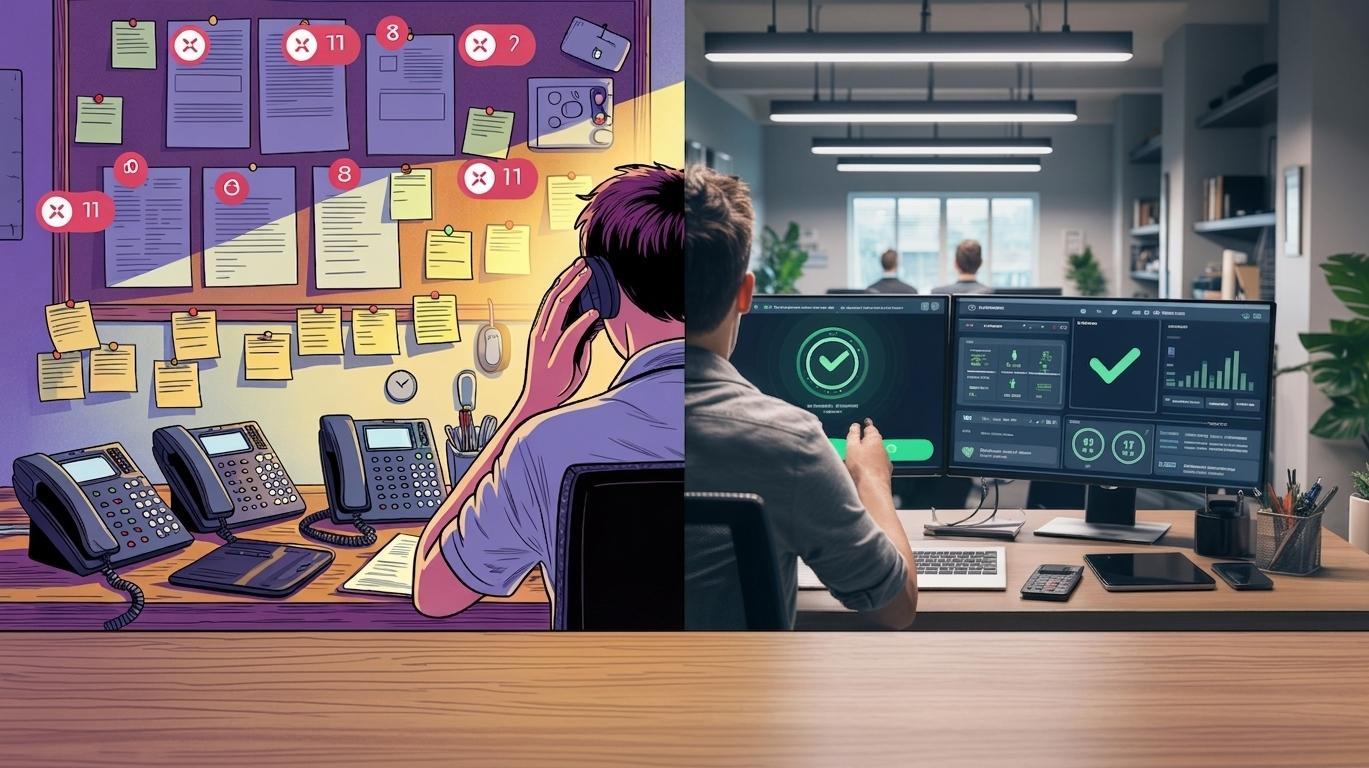
The Call That Killed a $4,000 Job
It was a Tuesday night in August. A homeowner's central AC unit had finally given out — temperature inside the house climbing past 85 degrees with two kids and a dog. She grabbed her phone and started calling HVAC contractors, working her way down the Google results. First number: voicemail.
Second number: voicemail. Third number: someone picked up on the second ring, confirmed availability, and booked the call for first thing Wednesday morning. That contractor walked away with a $4,200 system repair.
The first two contractors never knew what they missed. Their phones were on. Their voicemails were full. And just like that, a job they paid to generate through Google Ads was gone before 9 PM.
This isn't a rare scenario. For mid-to-high volume home service businesses — HVAC, plumbing, electrical, roofing — it's Tuesday night, every night.
The Real Question Isn't "Will It Reduce My Phone Bill?"
When contractors ask whether an AI receptionist will reduce their phone bills, they're usually thinking about the wrong number. The question worth asking is: how much money am I losing because my phone isn't being answered?
The answer, backed by data, is significant.
Home service businesses miss around 27% of their inbound calls on average, with each missed call costing approximately $1,200 in lost revenue. For small-to-medium operators, that miss rate can climb as high as 62%.
Run the math on your own business. If you're missing even five calls per week at an average job value of $500, that's $130,000 in potential annual revenue walking out the door — silently, invisibly, month after month.
And the costs go further than the job itself. Every missed call represents:
- Wasted ad spend. If you're investing in Google Ads or Local Services Ads to drive inbound calls and nobody picks up, that marketing dollar generated zero return.
- Lost lifetime value. The emergency plumbing customer who gets ignored today would have become a maintenance contract tomorrow — and would have referred three neighbors over the next five years.
- Reputation damage. Research has found that 37% of one-star reviews specifically cite missed or unreturned phone calls.
The question isn't whether an AI receptionist will trim your phone bill. The question is whether it will stop the hemorrhage you probably haven't fully measured yet.
After-Hours: Where the Real Bleeding Happens
Here's the stat that should stop every HVAC owner cold: 60% of buyer-intent calls happen outside of regular business hours.
When your office closes at 5 PM, your customers don't stop having emergencies. A burst pipe doesn't check the clock. A failed furnace on a February night doesn't wait until morning. These are your highest-urgency, highest-margin calls — and most home service businesses are sending them straight to voicemail.
Home service companies receive an estimated 8 to 12 after-hours calls per week. At an average emergency ticket of $500, that's over $120,000 in potential annual revenue disappearing into an unanswered voicemail box every year.
Even worse: only about 20% of callers leave a voicemail when they don't reach a live person. The rest hang up and call the next contractor on Google. They are not calling you back in the morning.
Your after-hours gap isn't a staffing inconvenience. It's a revenue gap with a dollar figure attached.
Speed-to-Lead: The Silent Tiebreaker
Even when calls come in during business hours, how fast you answer determines whether you win the job. This isn't a theory — it's a documented competitive reality.
Research from MIT and Harvard Business Review found that leads contacted within five minutes are 100 times more likely to make contact compared to those contacted after 30 minutes. Meanwhile, 78% of buyers go with the first business that responds to their inquiry — regardless of price, reviews, or experience.
In home services, where a homeowner typically contacts three to five contractors before making a decision, being second to answer is functionally the same as not answering at all. The job is gone before you return the call.
And the window is shrinking. In 2020, the average caller was willing to wait about 8 seconds for an answer. By 2026, that patience has dropped to just 2.3 seconds. Customers expect instant.
Voicemail is a conversion killer.
Your Dispatchers Are Doing the Wrong Work
There's another cost most contractors don't factor in: the value of their people.
A skilled dispatcher or service coordinator can typically manage routing, prioritize emergency calls, close inbound estimates, and keep trucks rolling efficiently. That's what they're worth. But when call volume spikes — during a summer heat wave, a winter cold snap, or a storm surge — those same people get buried in basic call triage. They're answering FAQ calls, taking down contact information, explaining service areas, and fielding price shoppers.
That's expensive work for an expensive person.
When your best operators are stuck handling repetitive, low-value call volume, they're not managing the high-value work that drives revenue. And during peak seasons — exactly when your phones are ringing the most — this problem compounds fastest.
What the Numbers Look Like When You Fix It
Enumsol's AI Voice Receptionists are purpose-built for exactly this problem. Deployed after a thorough audit of your actual call data and missed conversation patterns, the system answers every inbound call in under two seconds — 24 hours a day, 365 days a year — and books jobs directly into ServiceTitan or Housecall Pro without involving your dispatching team.
The results are measurable and specific:
- An HVAC client saw a 58% increase in after-hours booked jobs within 90 days.
- A plumbing client captured 4.3 times more qualified emergency calls per week.
- A roofing client reduced speed-to-lead on high-value estimates by 40%.
These aren't feature metrics. They're revenue metrics — the only kind that matters to a business owner managing trucks and job margins.
The Audit-First Difference
What separates a real solution from another SaaS tool promising to fix your phones is how the deployment starts.
Before a single workflow is built, Enumsol audits 30 days of your call logs and missed conversation data to identify exactly where revenue is leaking — not where you assume it is. From there, a focused proof of concept runs for two weeks on a single channel, measuring call pickup rate, qualified leads generated, and jobs booked against your existing baseline.
Nothing gets scaled until it produces verifiable revenue. Your team stays in control of high-value dispatching. The system handles the rest.
This audit-first approach is the reason results are reliable — and it's the reason contractors who've been burned by generic tools respond differently to it.
So, Will It Reduce Your Phone Bill?
Probably not in the way you're thinking. An AI receptionist doesn't compress your telecom costs. What it does is make every dollar you've already spent on marketing work the way it was supposed to.
You paid to generate those leads. Your Google Ads budget, your Local Services Ads, your referral machine — all of it drives traffic to your phone number. When that phone doesn't get answered, you don't just lose the job. You lose the ad spend, the lifetime value, the referral chain, and the competitive ground to whatever contractor picked up first.
Enumsol's AI Voice Receptionists don't reduce what you spend on your phone. They recover what you've been silently losing through it.
Conclusion
The trades reward the contractor who answers first, every time, without exception. Missed calls aren't a minor inefficiency — they're a measurable, compounding revenue problem that grows quietly in the background while you're focused on running jobs. Between after-hours gaps, dispatcher overload, and the brutal math of speed-to-lead, most home service businesses are carrying a revenue leak they've never fully calculated. The fix isn't adding more staff or spending more on ads — it's ensuring the leads you've already paid to generate are actually captured, qualified, and booked.
The real question isn't whether you can afford to implement a smarter call-handling system — it's how much longer you can afford not to: what would it mean for your business if you could recover just half of the calls you lost last month?
Sources: 411 Locals Business Phone Answering Study; MIT / InsideSales.com Lead Response Management Study – Dr. James Oldroyd; Harvard Business Review “The Short Life of Online Sales Leads” (2011); SwingPoint Media Impact of Missed Calls on Customer Satisfaction.