
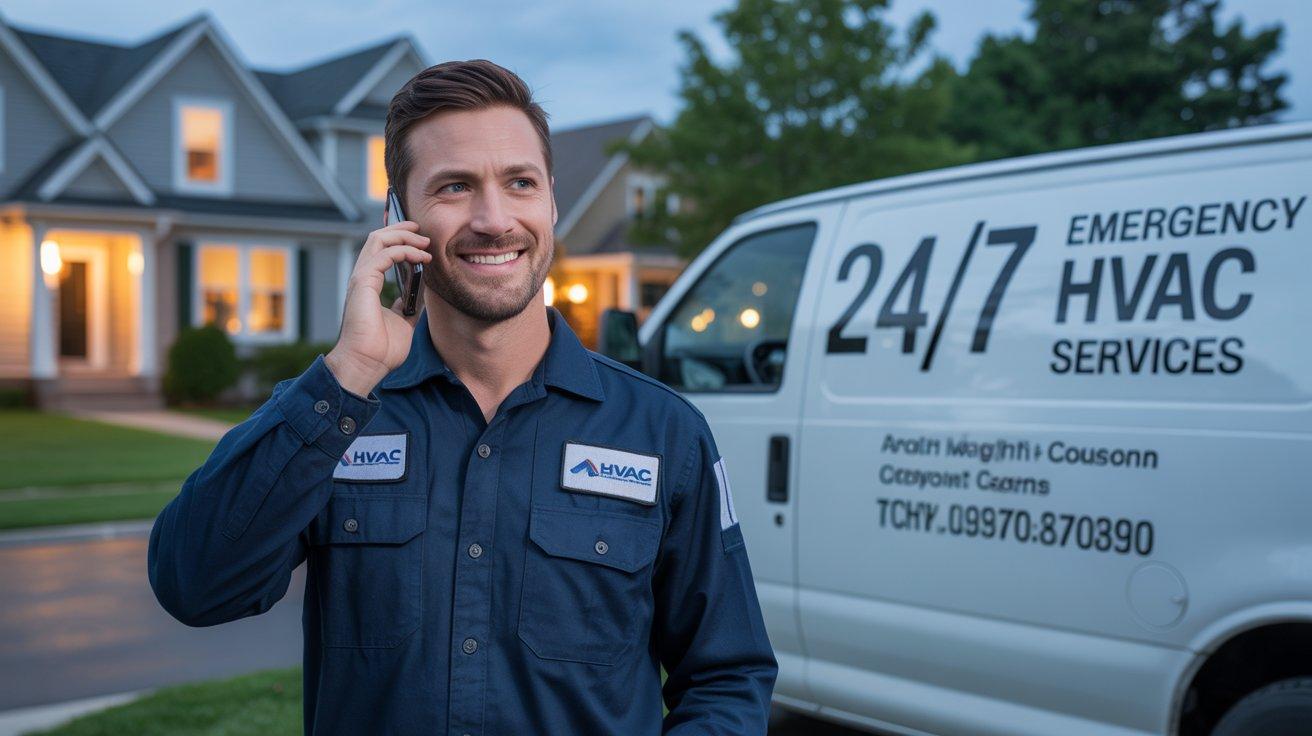
It's 9:47 on a Tuesday night in July. A homeowner in suburban Atlanta just walked into a wall of warm air — her AC quit sometime after dinner. She grabs her phone and opens Google. She calls the first HVAC company that comes up.
No answer. She calls the second. Voicemail. She calls the third.
Someone picks up, confirms they have a tech available tomorrow morning, and books the job in under three minutes. The first two companies will never know she called. Their Google Ads budget ran that day. They paid for her attention, earned her click, and then handed the job to a competitor — silently, invisibly, at 9:47 PM — because nobody was there to answer the phone.
That scenario isn't a worst-case. It's Tuesday.
The Revenue You're Paying For and Not Collecting
If you're running a mid-to-high-volume home service operation — HVAC, plumbing, electrical, roofing — you're already spending real money to make your phone ring. Google Local Services Ads. SEO. Direct mail.
Referral programs. Every one of those dollars is buying you a shot at a phone call. What happens to that call determines whether the dollar was an investment or a donation.
The numbers are not kind. Home service contractors miss between 27% and 62% of inbound calls, according to industry research — because their teams are physically in the field where phones don't get answered, or because calls come in after hours when no one is staffed. A contractor missing just five to ten calls per week — at an average job value of roughly $275 to $1,200 depending on the trade — can quietly lose between $45,000 and $120,000 in revenue annually, often without ever seeing it on a report.
And here's what makes it worse: the customer who couldn't reach you almost certainly isn't coming back. 85% of callers who reach voicemail never call back, and 62% immediately contact a competitor instead. Your marketing budget generated the lead. Your competitor's answered phone closed the job.
The After-Hours Problem Is Not a Small Problem
Most contractors assume their after-hours exposure is minimal — a few calls here and there, handled by a voicemail that customers will respond to in the morning. That assumption is expensive.
Buyer-intent calls in home services skew heavily toward after-hours windows. Homeowners aren't calling about their broken furnace at 2 PM on a Wednesday — they're at work. They're calling at 7 PM when they get home and realize the heat is out. At 10 PM when the pipe under the sink finally lets go.
At 6 AM before a contractor's phones open. Industry data shows that 30 to 60% of high-intent calls to HVAC, electrical, plumbing, and appliance repair businesses go unanswered during work hours or after hours. Those aren't low-value curiosity calls. Those are "I have an emergency, please help me" calls — the highest-margin jobs on your board.
The Aire Serv franchise network put this to the test when they switched from traditional live answering to an AI voice solution. Their after-hours bookings jumped from 58 per month to 208 per month — a 258% increase — with a 90% booking rate on those calls. The calls were already coming in. They were just going unanswered.
Speed Is the Actual Product
In home services, the difference between winning and losing a job is often measured in minutes — not price, not reputation, not years in business.
Research from Harvard Business Review and MIT, analyzing over 15,000 leads, found that businesses responding to an inbound inquiry within five minutes are 100 times more likely to make contact and 21 times more likely to qualify that lead compared to those who wait thirty minutes. After the five-minute window closes, lead quality drops by 80%. And the average home service business takes 42 minutes to respond — if it responds at all.
78% of customers hire the first contractor to respond with a clear next step. Not the best-reviewed contractor. Not the cheapest. The first one to pick up and say, "We can help — let me get you on the schedule."
Your dispatchers know this. They're trying to keep up. But a dispatcher managing an active board during a summer surge isn't built for instant response to every inbound inquiry — especially when those inquiries are coming in after 6 PM and on weekends, when your office is closed and your phones roll to voicemail.
What Dispatchers Are Actually Doing — and Why It Matters
Here's a conversation that happens in almost every mid-volume home service operation: the owner or ops manager is frustrated that bookings aren't tracking with lead volume. Marketing says the leads are there. Dispatch says they're doing their best. And somewhere in the gap, jobs are disappearing.
The issue often isn't that your dispatchers aren't good at their jobs. It's that answering cold inbound calls — qualifying callers, gathering addresses, explaining availability, handling FAQs about pricing and service areas — is low-value, high-volume work that consumes the attention of people you're paying to coordinate truck rolls, manage scheduling conflicts, and keep your field teams moving efficiently.
Every time a skilled dispatcher stops what they're doing to answer a basic inquiry call, they're not doing the job you actually need them to do. And when call volume spikes — during a cold snap, a summer heat wave, or a storm — the overflow doesn't get answered at all. The leads just vanish.
The real cost isn't the software or the headcount. It's the $800 water heater replacement, the $3,500 electrical panel job, the $6,000 HVAC equipment sale — the calls that never got answered while your team was already stretched.
Do AI Receptionists Actually Work?
The honest answer: for the specific problems contractors face — after-hours gaps, dispatcher overload, and speed-to-lead failure — yes, they work. With meaningful caveats.
The data from businesses that have deployed AI voice handling in home services is increasingly concrete. Sameday AI, one of the more widely used AI phone systems in the trades, reports a 92% booking rate across its home service customer base and has processed over two million calls in the trades. The HVAC and plumbing platform Granite Comfort, which deployed AI across nine of their brands in 2025, consolidated nine separate call centers into one and saw one of their pilot brands — Yost & Campbell — grow revenue 20% year-over-year, driven primarily by calls the team had previously been losing.
Research across businesses using AI receptionists shows a 67% reduction in abandoned calls, with AI systems resolving 90 to 95% of calls without requiring a human to step in. The calls that do need a human — true emergencies, complex quotes, upset customers — get routed immediately. The rest get handled, booked, and logged while your team focuses on the work they're actually trained for.
This matters for a ServiceTitan or Housecall Pro shop specifically. You already have the operational infrastructure. The job creation workflow exists. The calendar integration exists.
An AI voice layer isn't asking you to rebuild your operation — it's plugging into the system you've already built and capturing the demand that's falling through the cracks at 9 PM.
What "Working" Actually Looks Like in Dollars
Forget features for a moment. Run the math on your own operation.
If your average job value is $800 and you're missing 20% of your inbound calls — a conservative estimate for a busy shop — how many calls is that per week? Per month? At what job close rate?
For a contractor fielding 150 calls per week with a 20% miss rate, that's 30 missed opportunities. At a 40% close rate and an $800 average ticket, that's roughly $9,600 in recoverable revenue. Per week. From calls that already rang your phone, that your marketing already paid for, that your brand already earned.
Industry research suggests the average small business loses $126,000 per year in revenue from missed calls. For home service businesses with higher average job values, that number climbs considerably. Roofing contractors in industry studies average 87 calls monthly but miss 76.6% — with quote requests for projects averaging $15,000, the math on annual missed revenue reaches well into six figures.
An AI receptionist that captures even a fraction of that demand doesn't need to be perfect. It needs to answer the phone.
The Audit-First Approach: What Separates Real Help From a Software Sales Pitch
Most contractors who've been pitched "AI solutions" before have a reasonable level of skepticism — and they should. The ecosystem is full of tools promising transformation and delivering dashboards.
The difference between a solution that moves revenue and a software subscription that doesn't is whether anyone took the time to understand your specific operation first. What percentage of calls are you currently missing? At what times of day? What's your average job value by category?
What does your after-hours call volume actually look like compared to your current coverage model?
That diagnostic work — a real call flow audit — is what separates a tool that solves your problem from one that adds another line item to your P&L. It's also what gives you a baseline against which you can measure actual results: not "the AI answered X calls," but "we recovered Y bookings we were previously losing, worth $Z."
This is exactly the approach Enumsol's AI Voice Receptionist is built around. Rather than leading with a feature list, the process starts with understanding where your operation is losing jobs — after-hours gaps, dispatcher overflow, slow response to inbound marketing leads — and configuring a solution around the specific revenue leak, not a generic call-handling product.
The Questions Worth Asking Before You Decide
If you're evaluating whether an AI receptionist makes sense for your operation, the useful questions aren't about technology. They're about revenue:
How many calls are you missing each week, and at what times? Pull your call data from the last 60 days. Unanswered calls during business hours point to a dispatcher bandwidth problem. Unanswered calls in evening and weekend windows point to an after-hours coverage gap. Both are fixable.
Neither is visible until you look.
What does a typical missed call cost you? Multiply your average job value by your close rate. That's your missed-call cost per incident. Multiply by the number of missed calls per week and you have a monthly revenue figure that's been walking out the door quietly.
Is your speed-to-lead competitive? If your inbound calls go to a dispatcher queue during business hours, what's the actual wait time before someone picks up? During surge periods? If you're not measuring it, you're not managing it — and your competitors may be answering faster.
What is your after-hours coverage strategy right now? Voicemail isn't a strategy. It's a revenue hole with a greeting on it.
Conclusion
AI receptionists work for home service contractors — but not because they're impressive technology. They work because they solve a structural problem that no amount of dispatcher effort or voicemail configuration can fix: the phone rings when no one is available, and the customer doesn't wait.
The contractors seeing real results from this aren't the ones who adopted it as a tech trend. They're the ones who got honest about how many leads they were paying for and not catching, ran the math on what that was costing them, and decided that an always-on voice layer was cheaper than the revenue they were hemorrhaging after 6 PM.
If your marketing is working — if your phones are ringing — then the most expensive problem in your operation right now might not be your cost per lead. It might be your cost per unanswered call, and the only real question left is: how many more jobs are you willing to lose before you find out exactly how many you've already missed?
Sources: Invoca Research; MIT Lead Response Management Study (Dr. James Oldroyd); Harvard Business Review; 411 Locals Industry Study; Avoca AI / Granite Comfort Case Study; Sameday AI Performance Data; Aire Serv / Avoca After-Hours Booking Data; CallRail Benchmarking Report; Newo.ai Industry Research; CustomerFlows Home Service Business Statistics 2026.