
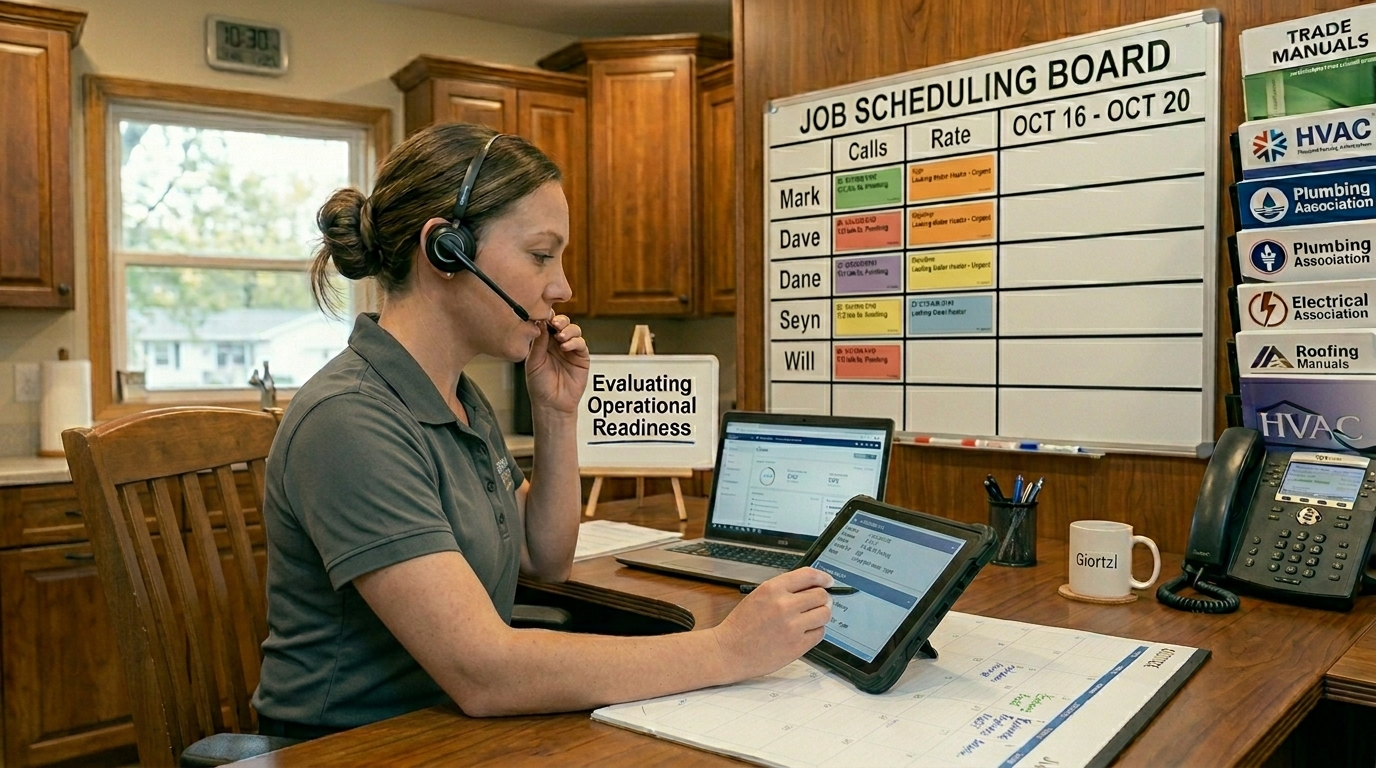
AI lead capture technology ensures every caller's information is recorded accurately. It's 10:12 PM on a Thursday in August. A homeowner's AC unit just quit. The house is already 83 degrees. Two kids are asleep upstairs.
She grabs her phone, finds an HVAC company on Google, and calls. Four rings. Voicemail. She hangs up without leaving a message — nobody does anymore — and calls the next company on the list.
That one picks up, gets her address, confirms the zip code is in their service area, marks the call as an emergency dispatch, and has a technician en route by 11 PM.
The first contractor never knew she called. Their marketing brought her in. Their phone lost her. And somewhere in their CRM, there's no record that any of this happened — because nothing was ever captured.
This isn't a staffing story. It's a data story.
The Real Cost of a Call That Goes Nowhere
Home service business owners tend to frame missed calls as a capacity problem. Not enough dispatchers, too many calls, someone was on another line. But the deeper problem isn't volume — it's what gets lost when a call doesn't result in a complete lead record.
When a call goes unanswered — or gets picked up by a dispatcher who's already juggling three other conversations and logs only a name and a callback number — you don't just lose the conversation. You lose every piece of information that would have let you follow up fast, route efficiently, and close the job.
According to CallRail's benchmarking research on inbound business calls, a significant share of inbound calls result in no recorded follow-up action. For contractors running Google Local Services Ads or seasonal campaigns, that means marketing dollars are generating calls that enter the pipeline and vanish without a trace.
And the downstream cost compounds. A lead with no address can't be routed. A lead with no service type can't be triaged. A lead with no urgency flag gets treated the same as every other inquiry sitting in the queue — and by the time someone calls back, the job is already booked with a competitor.
What a Purpose-Built AI Receptionist Captures
This is where operations shift from reactive to intentional. A voice AI system designed specifically for the trades — not a generic answering service, not a chatbot bolted onto a phone line — conducts a structured intake on every inbound call in under two seconds. Your dispatcher receives a complete lead record, not a voicemail to decode.
Here's what gets captured on a typical call:
Caller identity and callback number. Name and number are collected immediately — even if the call drops midway through. This one capability alone closes one of the most common revenue leaks: the caller who hangs up before anyone picks up and never calls back.
Service address and zip code. The AI confirms whether the address is within your service territory before the conversation goes any further. No more dispatchers spending ten minutes on a call for a job that's forty-five minutes outside your coverage area.
Nature of the request. Is this an emergency dispatch? A routine maintenance call? A new system inquiry? A warranty follow-up?
The call type is classified in real time, which determines how it's handled, routed, and prioritized in your queue.
Urgency level. A burst pipe at 2 AM and a slow drain on a Tuesday are not the same call. An AI receptionist trained for the trades understands how to surface urgency signals accurately — and flag high-priority jobs for immediate dispatch rather than letting them sit in a general intake queue.
Preferred scheduling window. For non-emergency calls, availability preferences are collected and used to book directly into your dispatch software — ServiceTitan, Housecall Pro, and similar platforms — without requiring a dispatcher to pick up the phone.
Access notes and special instructions. Gate codes, pet warnings, HOA requirements, second-floor units — details that would normally get lost between a dispatcher's handwritten notes and your CRM are captured and attached to the job record automatically.
Why Captured Data Is Worth More Than the Call
Most contractors think about a missed call in terms of the job value — and they're right to. A missed emergency HVAC call in the middle of summer can represent $800 to $2,500 in lost revenue on a single transaction. But the complete lead record that gets generated from a well-handled call is worth even more over time, because it's what makes every downstream action faster and more profitable.
The MIT Lead Response Management Study, conducted by Dr. James Oldroyd, found that the likelihood of successfully contacting a lead drops by more than ten times if the first follow-up attempt happens after just one hour. For a home service business operating at volume, that finding has a direct operational implication: a lead captured at 10 PM — with a name, callback number, service address, urgency level, and service type already in your system — can be dispatched or followed up on the moment your office opens in the morning. Without that complete record, the lead has already gone cold.
Invoca's research into inbound call behavior consistently shows that phone calls convert to customers at a substantially higher rate than digital form submissions — making call data one of the highest-value assets in your entire marketing funnel. But only if it's captured before the caller hangs up.
After-Hours Is Where the Data Gap Bleeds the Worst
Industry research consistently shows that roughly 60 percent of high-intent inbound service calls happen outside standard business hours — evenings, early mornings, and weekends. These are the calls from homeowners dealing with real emergencies: no heat in January, flooded basements on Saturday morning, AC failures in the middle of a heat wave.
These are also the calls that go to voicemail most often. And voicemail doesn't collect data. It collects silence — followed by a hang-up.
Research from Aire Serv's after-hours booking analysis found that businesses equipped to capture and act on after-hours caller data saw a material increase in emergency job bookings compared to those relying on voicemail and morning callbacks. The data capture is what enables the dispatch. One can't happen without the other.
Enumsol's AI Voice Receptionists operate specifically inside this gap. Running 24 hours a day, seven days a week, they capture complete caller data — name, address, service type, urgency — and push it directly into your dispatch software so nothing leaks out of the pipeline overnight. The result is a structured queue of qualified leads waiting for your team when the office opens, not a stack of voicemails and a morning spent playing catch-up.
The Dispatcher Problem No One Talks About
There's a cost to poor data capture that doesn't show up on a profit-and-loss statement — but every operations manager feels it by midday on a busy Monday.
When dispatchers handle high call volume manually, they're doing two jobs at once: managing a live conversation and logging information into your system in real time. Under pressure — during a seasonal spike, a marketing campaign surge, or a morning rush after a weather event — one of those jobs gets deprioritized. And it's almost always the data entry.
The 411 Locals industry study identified incomplete lead records and dispatcher entry errors as among the most commonly cited causes of missed follow-up in home service operations. Addresses get transposed. Callback numbers get logged incorrectly. Urgency flags get skipped because the dispatcher was already fielding the next call before finishing the last record.
This isn't a performance problem. It's a systems problem — and it compounds at exactly the moments when your business needs it least.
Research from Sameday AI performance data found that home service companies using automated call intake reported a notable reduction in data entry errors compared to dispatcher-logged calls, translating directly into fewer wrong-address dispatches, missed callbacks, and scheduling conflicts that waste truck time and erode customer trust.
What Complete Data Actually Unlocks in Your Dispatch Workflow
Capturing caller information is only useful if it flows into the right place automatically. A voice intake process that collects data and dumps it into a spreadsheet or a disconnected notes field hasn't solved the problem — it's just moved it downstream.
The real operational value comes from native integration with your existing dispatch platform. When caller data flows directly into ServiceTitan or Housecall Pro — structured, complete, and tagged correctly — it creates a job record, triggers the appropriate technician assignment workflow, and becomes part of your operational reporting without any manual handoff.
CustomerFlows Home Service Business Statistics 2026 found that businesses with structured, automated call intake processes report measurably higher lead-to-book conversion rates compared to those relying on dispatcher-logged entries. The gap isn't marketing performance. It's what happens between the ring and the job ticket.
For a contractor thinking in terms of truck rolls and job value — not software dashboards — this is a straightforward equation: more complete data entering the system means more jobs getting booked, more technicians dispatched efficiently, and less revenue walking out the back door every time a phone goes unanswered.
Real Numbers From Real Operations
The outcomes that follow from fixing data capture aren't incremental. They compound.
An HVAC client working with Enumsol's AI Voice Receptionists saw a 58 percent increase in after-hours booked jobs over 90 days. Not because their marketing improved. Not because they hired more dispatchers. Because the after-hours calls that were previously going to voicemail — and generating no data, no follow-up, and no revenue — were now being captured, triaged, and routed automatically.
A residential plumbing client captured 4.3 times more qualified emergency calls per week after implementing automated call intake. The calls were always coming in. The data was just never making it into the system.
A roofing contractor reduced speed-to-lead time by 40 percent on high-value estimate calls — because the lead information was already structured and ready for follow-up before a human ever touched the record.
Newo.ai industry research supports a consistent pattern across home service verticals: businesses that capture complete caller data at intake — versus those relying on dispatcher memory, voicemail transcription, or manual logging — consistently outperform on conversion rates and average job value per lead, regardless of marketing spend.
Conclusion
The calls are already coming in. Your marketing is already working. Homeowners in your service area are picking up the phone with the intent to hire — and the majority of them are calling during hours when no one is available to collect their information properly.
Every unanswered call, every incomplete intake, every voicemail that never gets returned is a data failure before it's a revenue failure. And for contractors running mid-to-high volume operations in HVAC, plumbing, electrical, or roofing — where a single missed emergency call represents thousands of dollars and a customer who will never call back — the cost of that data gap adds up every single night.
You've already paid for the lead. The only question left is: does your current system have any real way of capturing it?
Sources: CallRail Benchmarking Report on inbound call follow-up rates in service businesses; Aire Serv After-Hours Booking Analysis on emergency call capture rates; Sameday AI Performance Data on automated intake accuracy versus dispatcher-logged entries; CustomerFlows Home Service Business Statistics 2026 on lead-to-book conversion across intake methods; Newo.ai Industry Research on caller data completeness and job value outcomes across home service verticals.